 Burn
Get Burn
Burn
Get Burn
HOME / FASTING / 16:8 VS 5:2
These are not two versions of the same thing. One is a daily window you never stop running; the other is two hard days a week and five ordinary ones.
One is a fasting schedule, the other a calorie protocol. Here is what that means in practice.
16:8
A DAILY WINDOW
Sixteen hours fasting, eight to eat, seven days a week. Nothing to count and nothing to plan once the window is set, which is why it becomes a habit rather than a decision.
5:2
A WEEKLY PATTERN
Nothing to think about on five days of the week. The other two are heavily reduced rather than zero, and taken as a single evening meal they come close to a 22 hour fast.
A 16:8 asks something of every day and not much of any of them. A 5:2 asks nothing of five days and a lot of two. On 5:2, a restricted day taken as a single evening meal comes close to a 22 hour fast, which is why it is shown here in the Ketosis Entry colour. Neither shape is obviously better; they suit different temperaments.
The real difference
The choice is less about hours than about how you would rather spread the difficulty across a week.
COUNTING
16:8 needs a start time and nothing else. 5:2 needs you to know roughly what you are eating on the restricted days, which is a different kind of attention.
SOCIALLY
This is 5:2's real advantage. A wedding, a holiday, a long lunch: put it on one of the five, and there is nothing to work around at all.
ADAPTATION
Doing the same thing every morning becomes routine. Two restricted days a week stay noticeable, because you never do them often enough to stop noticing.
Choosing
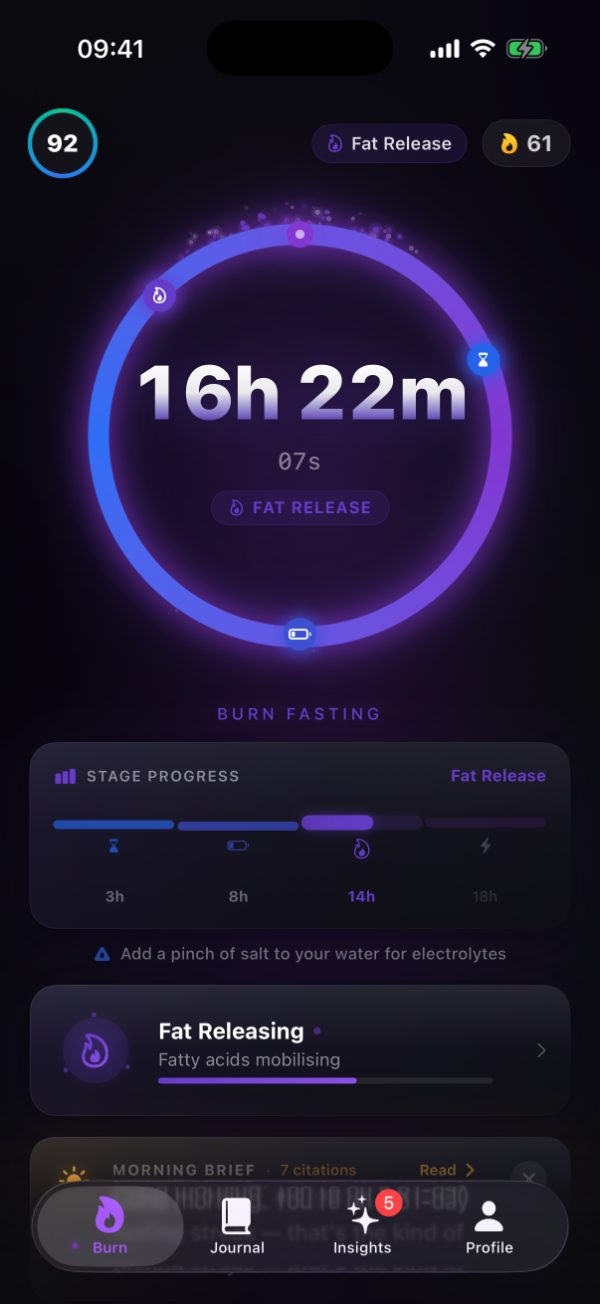
A daily window becomes automatic in a way that two hard days never quite does. It is also the pattern Burn is built around, so the timer, the stages and the streaks all follow it directly.
If breakfast meetings, shift work or family meals make a fixed daily window unrealistic, two chosen days beat a schedule you break four times a week.
Eat-Stop-Eat keeps 5:2's two-day rhythm but makes those days complete 24 hour fasts, so there is nothing to weigh or tally on either kind of day.

Both patterns produce weight loss in controlled human trials, comparable to other approaches at matched intake. No trial establishes that a weekly pattern outperforms a daily one. Which pattern a person can sustain matters more than which is theoretically optimal. Claims here are drawn from peer-reviewed research and traced in our evidence policy.
Burn times fasts and names the stage the clock has reached. It does not count calories, so 5:2's restricted days are yours to manage. Speak to your doctor first if you are pregnant or breastfeeding, have a history of eating disorders, manage diabetes, take medication timed to meals, or are under 18.
Burn times every fast, names the stage you reach, and keeps the record of the weeks that held.
Download free on the App StoreiPhone, iPad, and Apple Watch. Requires iOS 18 or watchOS 11.