 Burn
Get Burn
Burn
Get Burn
Burn
Get Burn
Burn
Get Burn
HOME / FASTING STAGES / 16 HOURS
By 16 hours without food, your liver's stored sugar is largely spent and your body is drawing more of its energy from fat. Ketone production has usually begun and is rising, though it is still modest at this point.
What elapsed time cannot tell you is where exactly you are in that shift. Sixteen hours is not a switch. It is a point on a slope that starts earlier for some people and later for others, depending on what you last ate, how much you moved, how you slept, and your own metabolism.
So Burn tells you two things at once: the stage you have reached, and how solid the science behind it is. You get the useful version and the accurate one.
Each band fades into the next because that is how the biology works. Burn tracks all four, so you always know which part of the shift you are in.
These get bundled together into one claim about "fat burning mode". They are four different things, running on four different timescales, with four different levels of certainty.
Your liver holds a limited store of sugar and releases it steadily between meals. Over roughly 12 to 16 hours that store gets low, which is what pushes your body toward other fuel.
Well established. How fast it drains depends heavily on your last meal and your activity.
As insulin falls, stored fat is released into the bloodstream as free fatty acids and burned for energy. This is not off and then on. It increases across the fast.
Well established as a direction. The exact rate at hour 16 varies between people.
The liver converts some fatty acids into ketone bodies, which the brain can use. At 16 hours this has usually started and is generally still low, rising further if you keep going.
Measurable with a blood or breath test.
A cellular recycling process that responds to nutrient scarcity. Much of what is claimed about its fasting timeline comes from animal or cell studies, not from measuring humans at hour 16.
Onset hour is not established in humans.
What tends to show up around this point, and what to do about each one.
Often stronger around hours 12 to 14 than at 16. It arrives in waves rather than a rising line.
Both are commonly reported. Which one you get seems to depend more on sleep and hydration than on the hour.
Usually about fluid and salt rather than the fast itself. Drink water. If it is more than mild, eat something.
Common and unremarkable at this length. Worth attention if it comes with shaking or a racing heart.
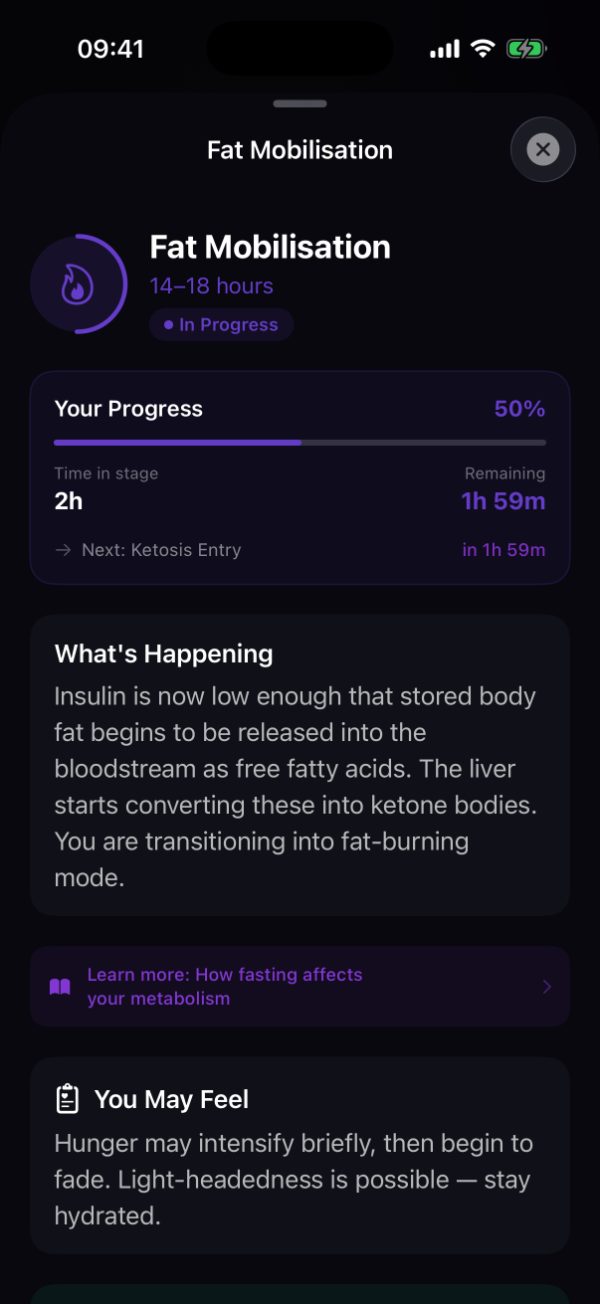
Burn's stage model
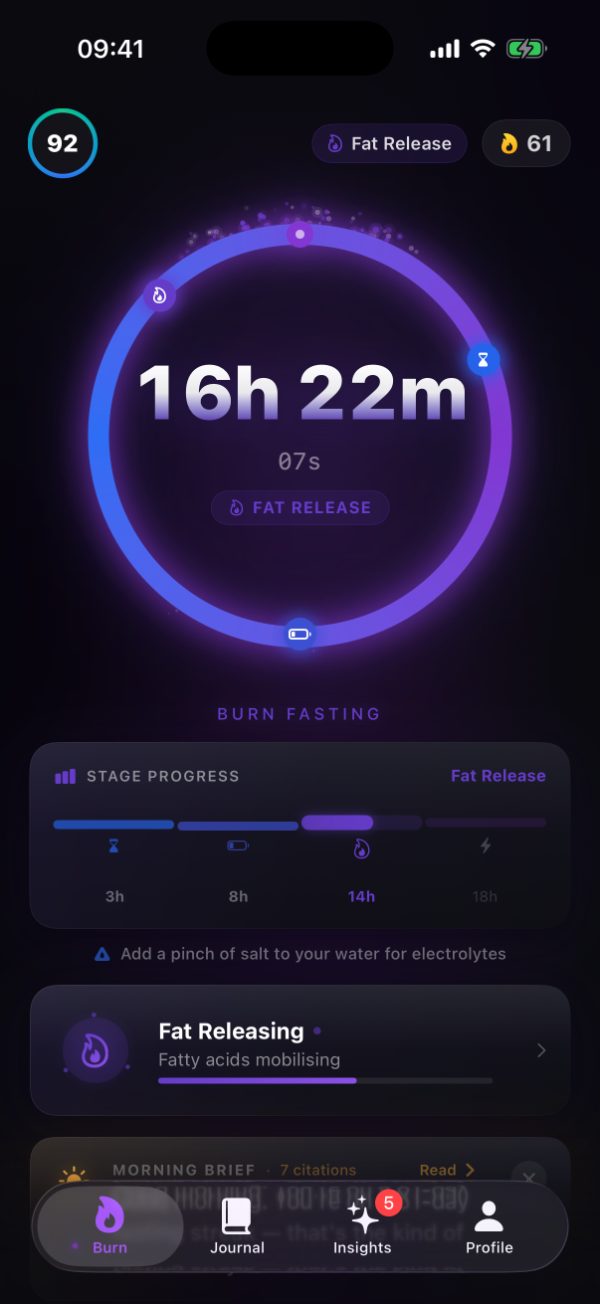
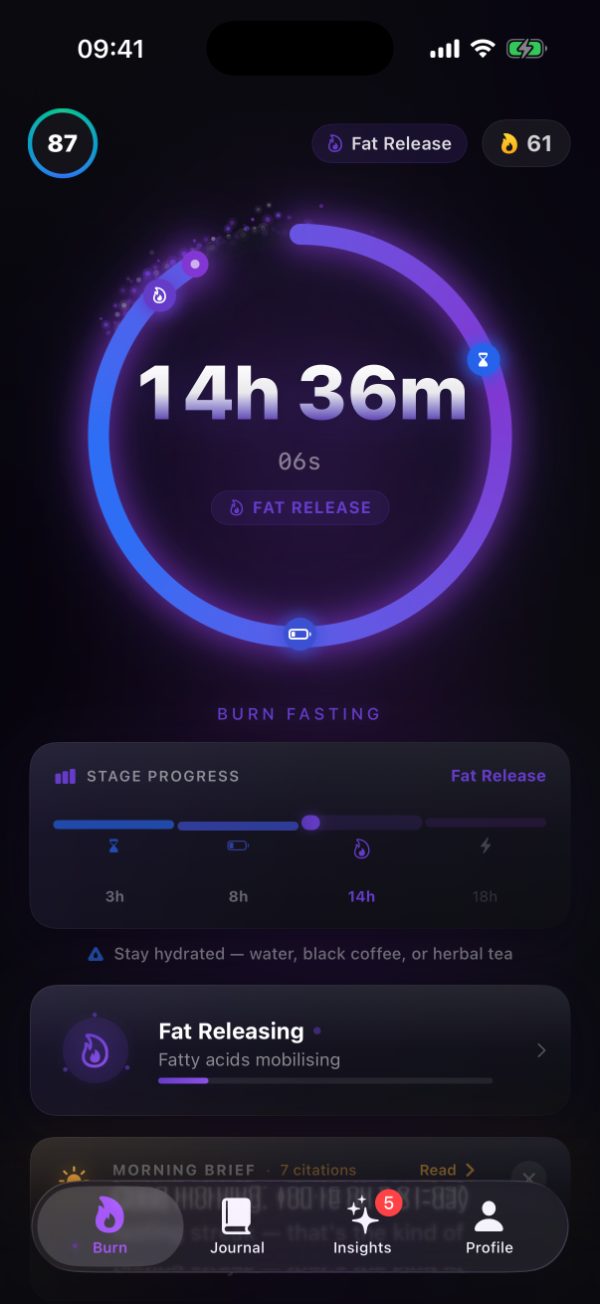
Burn places hour 16 inside a band it calls Fat Mobilisation, running from 14 to 18 hours. In the app the timer pill reads FAT RELEASE.
That band comes from elapsed time, not from a sensor. Burn is precise about which is which, on every screen and every page, so you always know what you are looking at.
BURN STAGE 4, 14-18H
"Insulin is now low enough that stored body fat begins to be released into the bloodstream as free fatty acids. The liver starts converting these into ketone bodies."
Sixteen hours is the everyday number. Two schedules land you there or just past it without rearranging your life.
Finish dinner at 8pm, eat again at noon. Hour 16 is the end of the fast, which makes this page a description of your last two hours every day.
Read the 16:8 guide →Hour 16 is a waypoint rather than the finish, and the two hours after it are where ketone production picks up most noticeably.
See all schedules →If you carry on past 16
The longer a fast runs, the more the considerations change: electrolytes, medication timing, and knowing which symptoms mean stop rather than push on.
Stop the fast and eat if you get dizziness or fainting, a racing or pounding heart, confusion, severe weakness, shaking with cold sweats, or vomiting.
Talk to a doctor before fasting at all if you are pregnant or breastfeeding, have a history of disordered eating, take insulin or medication timed with food, or manage diabetes.
Read the full safety guidance →Burn names the stage as you cross it, and tells you how solid the science behind it is.
Download free on the App StoreiPhone, iPad, and Apple Watch. Requires iOS 18 or watchOS 11.