 Burn
Get Burn
Burn
Get Burn
Burn
Get Burn
Burn
Get Burn
HOME / FASTING STAGES / 12 HOURS
Twelve hours sits two thirds of the way through Glycogen Depletion. Your liver's stored glucose is running low, fat is starting to contribute more of your energy, and hunger usually arrives somewhere around here.
Nothing dramatic has happened yet. This is the stage that decides whether you reach the ones where it does.
It is also where a 12:12 finishes, which makes it the first genuine milestone for anyone starting out.
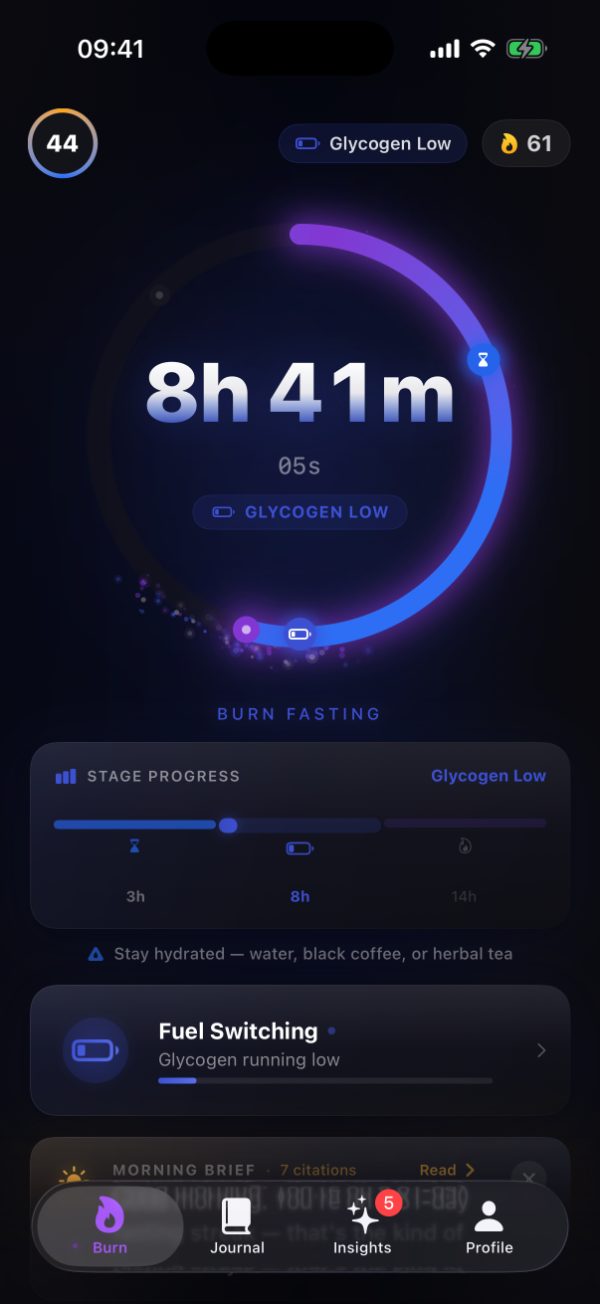
On the timer screen, where space is tight, Glycogen Depletion shows as GLYCOGEN LOW.
The stage itself
What's happening
Liver glycogen stores are becoming depleted. Your body increases fat oxidation to compensate. Glucagon rises to help maintain blood sugar. Early ketone production may begin.
You may feel
Hunger may increase. Some notice mild irritability. Others report improving focus as the body adapts.
Hunger and improving focus in the same stage is not a contradiction. They arrive at different points, and which one you notice depends on when you last ate and what it was.

Your liver holds enough glucose for a limited stretch, not for days. Twelve hours in, that store is well down and fat is covering more of the gap.
Glycogen is stored with water, so running it down means losing fluid. Weight that moves in the first days of fasting is mostly this, and it comes back when you eat.
Fat Mobilisation opens at 14 hours. If you are going further than 12, the next stretch is short and it is where the fast starts to earn its name.
Reaching this hour
Twelve hours is the shortest fast Burn treats as a schedule in its own right, and the first target for anyone who has never fasted deliberately.
12:12
Finish dinner at eight, eat again at eight. Much of it happens while you are asleep, which is why it works as a starting point. Burn grades it Beginner.
Compare the beginner schedules →16:8
Passes 12 hours with four still to go, arriving two hours into Fat Mobilisation. The stretch between 12 and 14 is where a fast starts to ask something of you.
The 16:8 guide →Getting through it
It peaks and passes rather than climbing steadily. The wave that arrives around now will subside whether or not you eat, which is the single most useful thing to know at this hour.
Water, black coffee or plain tea. None of them break the fast, and thirst is easy to read as hunger. Burn's Struggle Support puts this first for a reason.
Glucagon is working to hold your blood sugar steady while glycogen runs down. Feeling short-tempered in this window is a normal part of that, not a sign the fast is going wrong.

WELL ESTABLISHED
That liver glycogen runs down across a fast and that fat oxidation rises to compensate is standard physiology, drawn from peer-reviewed research and traced in our evidence policy.
VARIES BY PERSON
Onset shifts with your last meal, your activity, your sleep and your metabolism. Burn names the stage at 8 hours because a timer has to draw a line. It maps elapsed time to named stages and does not measure ketosis, autophagy, or metabolic state.
Burn names all nine stages as you reach them, with a buzz on your wrist at every boundary.
Download free on the App StoreiPhone, iPad, and Apple Watch. Requires iOS 18 or watchOS 11.