 Burn
Get Burn
Burn
Get Burn
Burn
Get Burn
Burn
Get Burn
HOME / FASTING / EAT-STOP-EAT
Two 24 hour fasts a week, on whichever days suit you. The other five days are normal, with no window to watch and nothing to count.
It asks a lot of two days so it can ask nothing of the rest. Burn runs it as an ongoing program, graded Intermediate.
Burn's version puts the fasts on Wednesday and Saturday. The protocol itself leaves the choice to you.
How a fasting day works
This is the detail that makes the protocol workable. A 24 hour fast run from one evening meal to the next means you never spend a whole calendar day without eating.
7PM TO 7PM
Finish dinner Tuesday, eat dinner Wednesday. You skip breakfast and lunch on one day, which is far less daunting than the phrase twenty-four hours suggests.
1PM TO 1PM
Better if your evenings are social. You miss dinner and breakfast instead, and the hard hours land in the morning while you are busy.
KEEP THEM APART
Back-to-back fasting days turn this into a harder schedule than it is meant to be. Burn's Wednesday and Saturday spacing leaves clear days either side.
What a fasting day reaches
A 24 hour fast passes Fed State, Early Fasting, Glycogen Depletion, Fat Mobilisation and Ketosis Entry, arriving at the Fat Burning boundary as it ends. Twice a week, that is a stage you would never reach on a daily 16:8.
A full day without food means no sodium coming in with meals. Burn shows an electrolyte reminder as a fast passes 24 hours and keeps sodium, potassium and magnesium in the Journal.
After 24 hours you do not need a careful refeed, but a very large meal will feel uncomfortable. Something ordinary, eaten slowly, is enough.
Hard efforts want glycogen, and a fasting day is the wrong day for them. Five ordinary days is plenty of room to put the demanding sessions somewhere sensible.
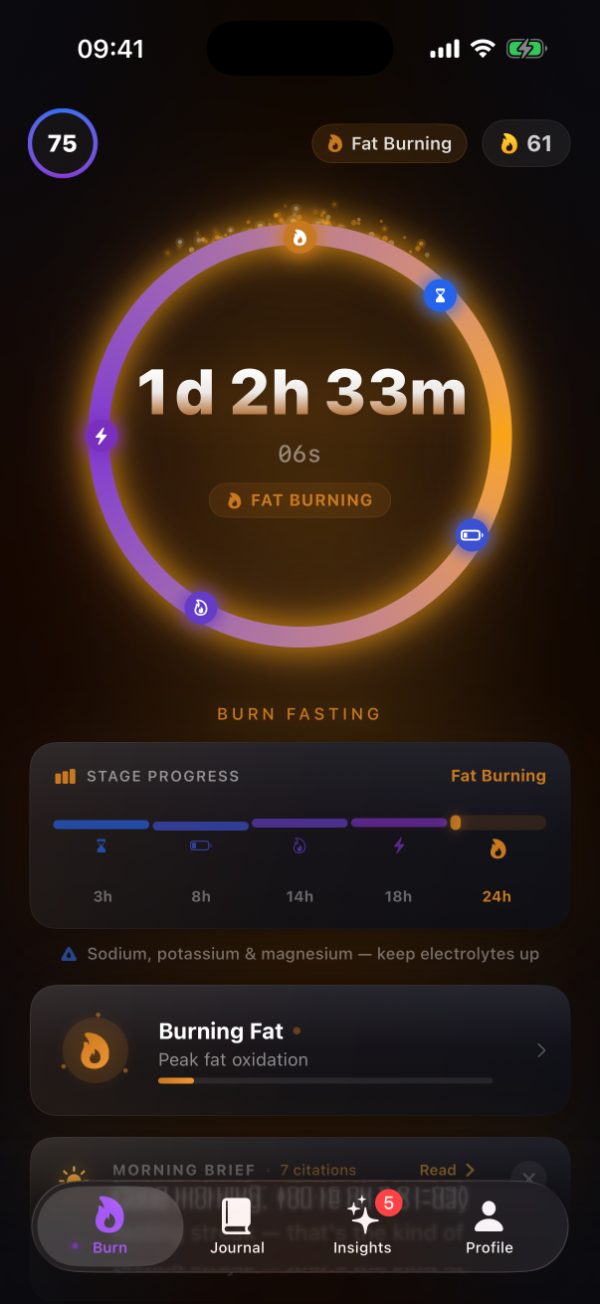
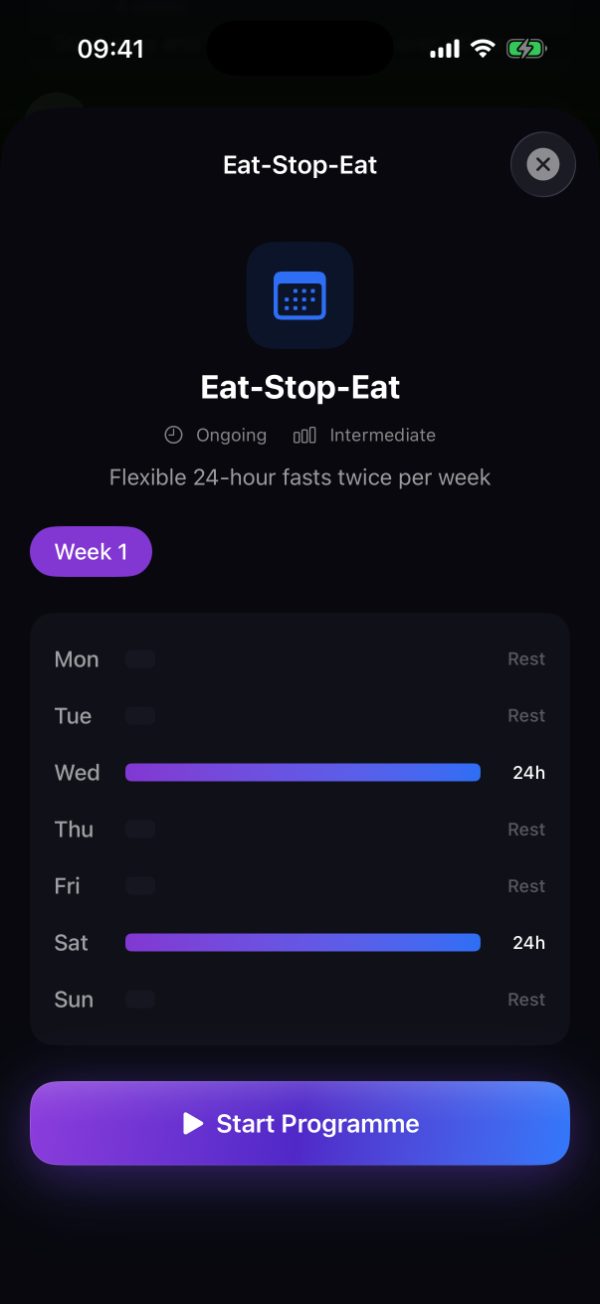
Running it in Burn
Eat-Stop-Eat is one of Burn's 21 programs. Unlike the fixed-length plans it has no end date, because the pattern is meant to be a permanent shape for your week rather than a two-week push.
A step below Alternate Day, which asks for three or four fasts a week. Two is a reasonable target once you have completed a few single 24 hour fasts.
Burn keeps completions, streaks and twelve personal records, so two fasts a week accumulate into something you can look back on rather than a vague sense of having done it.
If Wednesday and Saturday do not fit your week, Burn's three custom protocols let you set any fasting and eating pattern and save it.
Eat-Stop-Eat or 5:2
Both use two demanding days and five ordinary ones. What separates them is whether the fasting day includes food at all.
Eat-Stop-Eat
A complete 24 hour fast, nothing but water, black coffee and plain tea. Reaches Fat Burning. Simpler to follow, because there is no counting involved on either kind of day.
Choose it if you would rather not eat at all than eat a little.
5:2
Two heavily reduced days rather than two zero days, in its traditional form. Easier to sit through a family dinner on, harder to follow without weighing anything.
Choose it if a small meal makes the day possible rather than harder.
BEFORE YOU START
Do not use this schedule if you are pregnant or breastfeeding, have a history of eating disorders, or are under 18. Speak to your doctor first if you manage diabetes or take medication timed to meals, since a full day without food changes how those doses land. Stop and eat if you feel unwell, whatever the timer says.
WHERE THE EVIDENCE STANDS
Intermittent fasting patterns produce weight loss in controlled human trials, comparable to other approaches at matched intake. Which pattern a person can sustain matters more than which is theoretically optimal. Claims here are drawn from peer-reviewed research and traced in our evidence policy.
Burn times each fast to the second, names every stage you reach, and keeps the record of the weeks that held.
Download free on the App StoreiPhone, iPad, and Apple Watch. Requires iOS 18 or watchOS 11.