 Burn
Get Burn
Burn
Get Burn
Burn
Get Burn
Burn
Get Burn
HOME / FASTING STAGES / 24 HOURS
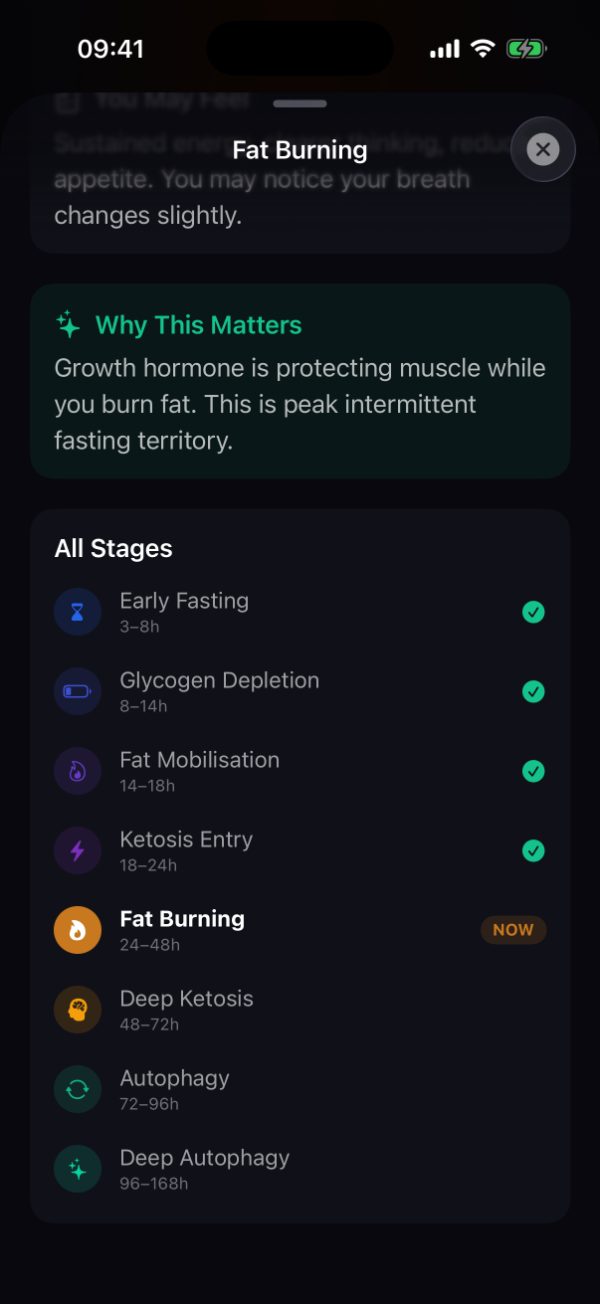
By 24 hours without food, your liver's stored glucose is essentially gone. Most of your energy is now coming from fat, and ketone levels are meaningfully higher than they were at 16 hours. This is the point Burn calls Fat Burning.
A full day is also where a fast stops being a schedule and becomes an event. It needs planning, it needs water and salt, and it is the first length where stopping early is a sensible decision rather than a failure.
Burn names the stage and tells you how firm the evidence behind it is.
The stage that opens at 24 hours runs for a full day of its own. Reaching the boundary is the start of it, not the end of anything.
Liver glycogen is spent, so the body is running mostly on fat and the ketones made from it.
A day without food is also a day without the fluid and sodium that food normally carries.
Reduced appetite is part of how Burn describes this stage, which surprises people expecting the opposite.
The stage itself
Sustained energy, clearer thinking, reduced appetite. You may notice your breath changes slightly.
Reduced appetite is the part people find surprising. Hour 24 is often easier than hour 14, because the peak passed long ago.
Why this matters
Growth hormone is protecting muscle while you burn fat. This is peak intermittent fasting territory.
Frequently down to fluids or sodium rather than the fast itself. Water with a pinch of salt often helps.
Common at longer fasts. Worth a sweater rather than a worry.
Sensations vary a lot between people. Burn's symptom check is there to tell you when something is not routine. See the support tools →
What the clock can say
Twenty-four hours is not a switch. It is a point on a slope that starts earlier for some people and later for others, depending on what you last ate, how much you moved, and your own metabolism.
WELL ESTABLISHED
That liver glycogen runs down over roughly this timescale, and that fat becomes the dominant fuel, is well described in the literature.
MEASURABLE WITH A TEST
Ketone levels can be measured with a blood or breath test. Burn names the stage the clock has reached, not a ketone number.
ACTIVE RESEARCH
Whether occasional full-day fasts produce outcomes beyond the reduced intake they cause is an active research area.
Burn maps elapsed time to named stages and does not measure ketosis, autophagy, or metabolic state.
Running one
You sleep through a third of it and you only skip breakfast and lunch, rather than facing a whole empty day.
Food normally supplies a fair amount of your fluid and sodium. Burn tracks water alongside the fast so you can see what you have actually had.
A first 24-hour fast on a day with heavy training or a demanding schedule is a harder test than it needs to be.
Not a feast, and not nothing. Eating your way back through the whole deficit is what stops a long fast achieving anything.


Before a full day
If you are pregnant or breastfeeding, have a history of disordered eating, manage diabetes, take insulin or medication timed with food, are underweight, or are recovering from illness, do not run a fast of this length without medical input.
Stop and eat if you feel unwell, whatever the timer says. Burn's symptom check is one tap from the timer. Burn is a tracking tool and nothing in it is medical advice.
Burn names all nine stages as you reach them, tracks your water alongside the fast, and has the support tools ready for the hours that are hard.
Download free on the App StoreiPhone, iPad, and Apple Watch. Requires iOS 18 or watchOS 11.