 Burn
Get Burn
Burn
Get Burn
HOME / GUIDES / HOW TO STICK TO FASTING
Fasting is simple for a week. Keeping it going for a year is the part worth planning for, and it is a design problem rather than a willpower problem.
Six things that make a schedule survive a real life, and the two failure modes to watch for.
The six that matter
Every one of these removes a reason to stop. None of them requires being more disciplined than you already are.
01
Not your best day. If 16:8 works when you are rested and fails when you are tired, your real schedule is 14:10. Choose for the tired version of yourself.
02
A window at the same hours every day becomes automatic. One that moves daily stays a decision, and decisions are what wear out.
03
A late dinner does not require abandoning the fast. Shift the whole window later and the length is unchanged.
04
Hunger arrives in waves that peak and pass. Knowing what you will do when the wave lands turns it into twenty minutes rather than a decision about whether to continue.
05
A lot of what reads as a discipline failure is a headache from low sodium. That is a supply problem, and it is solved in the kitchen.
06
Weight moves for reasons that have nothing to do with your fast, and a bad reading is a reason to quit. Fasts finished is the number you control.
Two failure modes
Neither of these is hunger, and both are avoidable once you can see them coming.
FAILURE MODE ONE
A single skipped fast is nothing. The problem is what happens next: the streak is broken, the week feels ruined, and the habit gets abandoned rather than resumed.
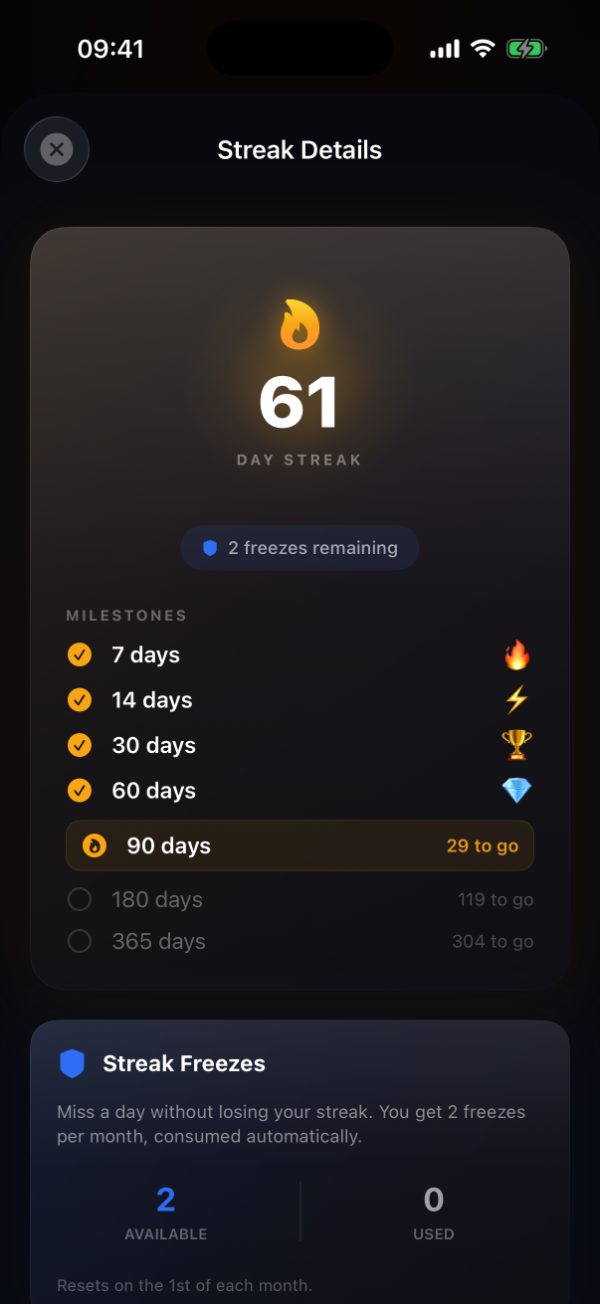
Streak Freezes exist for this. A missed day is covered, the record stays intact, and there is no ruined week to walk away from.
FAILURE MODE TWO
A good week at 16:8 makes 18:6 tempting. Then a hard week arrives, 18:6 fails twice, and the whole thing feels like it is not working.
Move up only when the current length stops taking effort. There is no prize for reaching a longer number faster.
What to watch instead
You cannot decide what the scale says tomorrow. You can decide whether tonight's fast gets finished, and that is what Burn keeps count of.
Milestones at 7, 14, 30, 60 and 90 days, and freezes that cover the days life gets in the way.
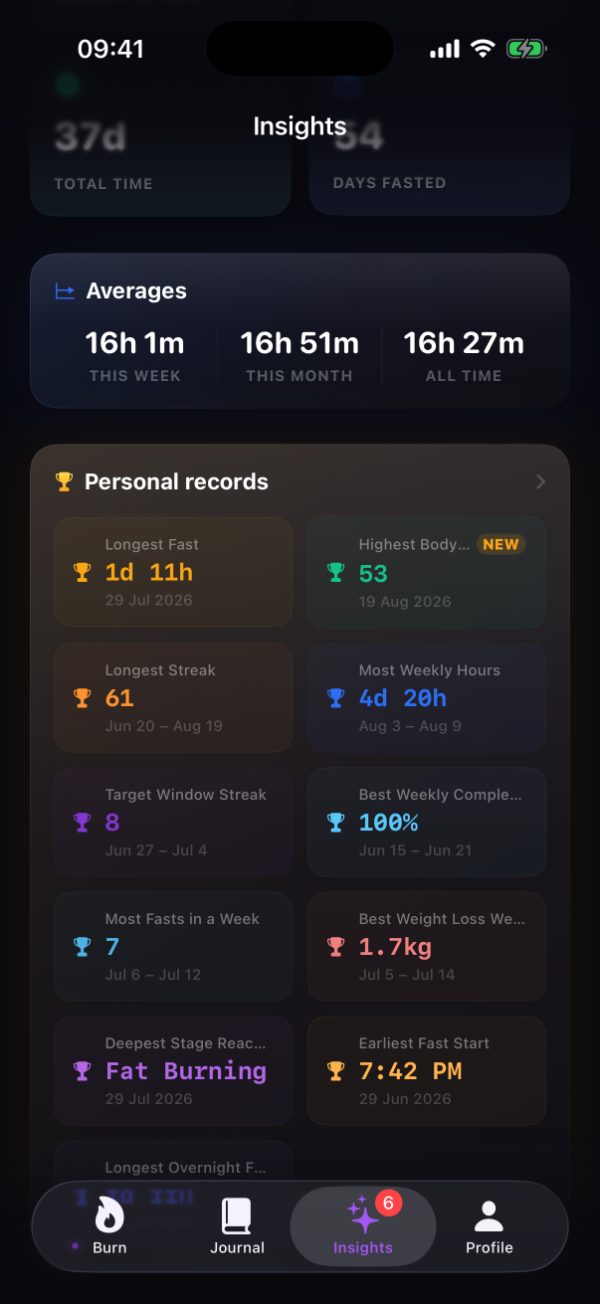
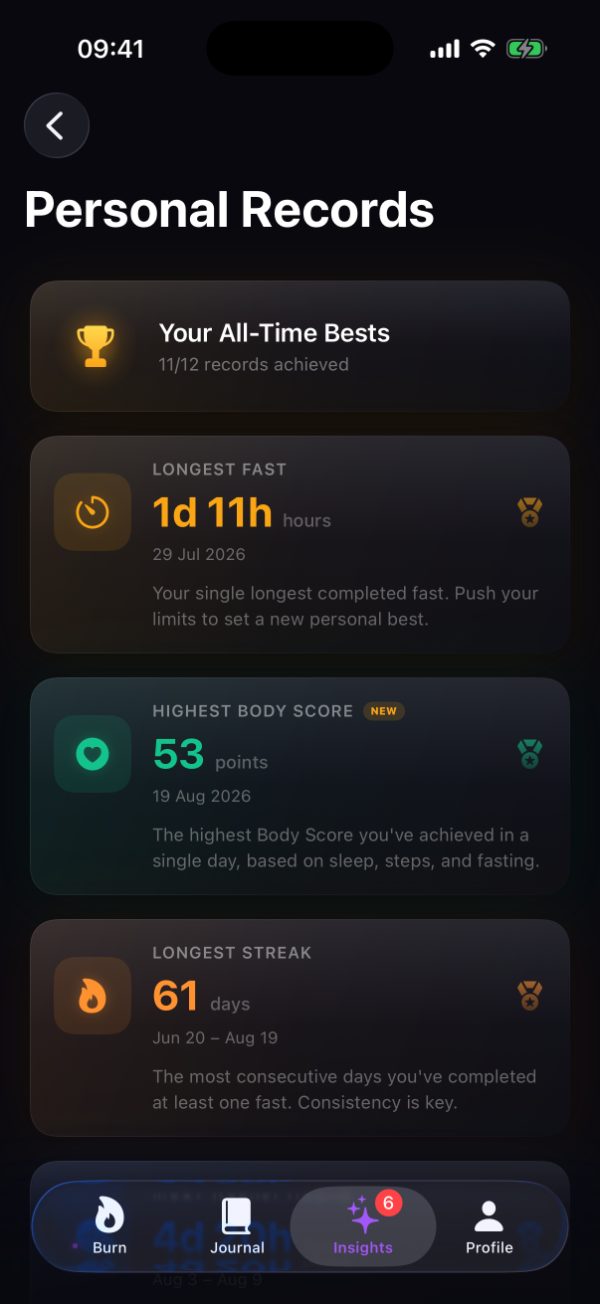
Longest fast, best week, most consistent month. Progress you can see without stepping on anything.
Insights charts hours per week and completion rate, so a rough patch reads as a dip in a line rather than a failure.

When it stops working
Several hard weeks in a row is information about the schedule rather than about you. Three ways to respond that keep the habit alive.
18:6 to 16:8, or 16:8 to 14:10. Hold the shorter length for two weeks before deciding anything else.
Weekdays fasted and weekends free is a schedule you can keep for years. A shorter week you sustain beats a full week you abandon.
A window that ends at 6pm fails if you eat dinner at 8. Moving the hours often fixes what looked like a length problem.
In controlled trials of time-restricted eating, results are comparable to other approaches at matched intake, and the pattern a person sustains matters more than the pattern that is theoretically optimal. Claims are drawn from peer-reviewed research and traced in our evidence policy.
Burn records the fasts you complete, the stage each one reached, and what you log alongside them. It does not measure ketosis, autophagy, or metabolic state.
Streaks with freezes, twelve personal records, and a completion rate you can read back week by week.
Download free on the App StoreiPhone, iPad, and Apple Watch. Requires iOS 18 or watchOS 11.