 Burn
Get Burn
Burn
Get Burn
HOME / GUIDES / LOW ENERGY WHILE FASTING
Low energy in the first two weeks is usually your body switching fuel sources. It typically settles. Low energy in week six is a signal to change something.
Four causes, in the order worth checking, and how to tell adaptation from a schedule that does not suit you.
Fatigue and weakness are often potassium, and low sodium drags energy down with it. This is the most common cause and the easiest to fix, which is why it goes first.
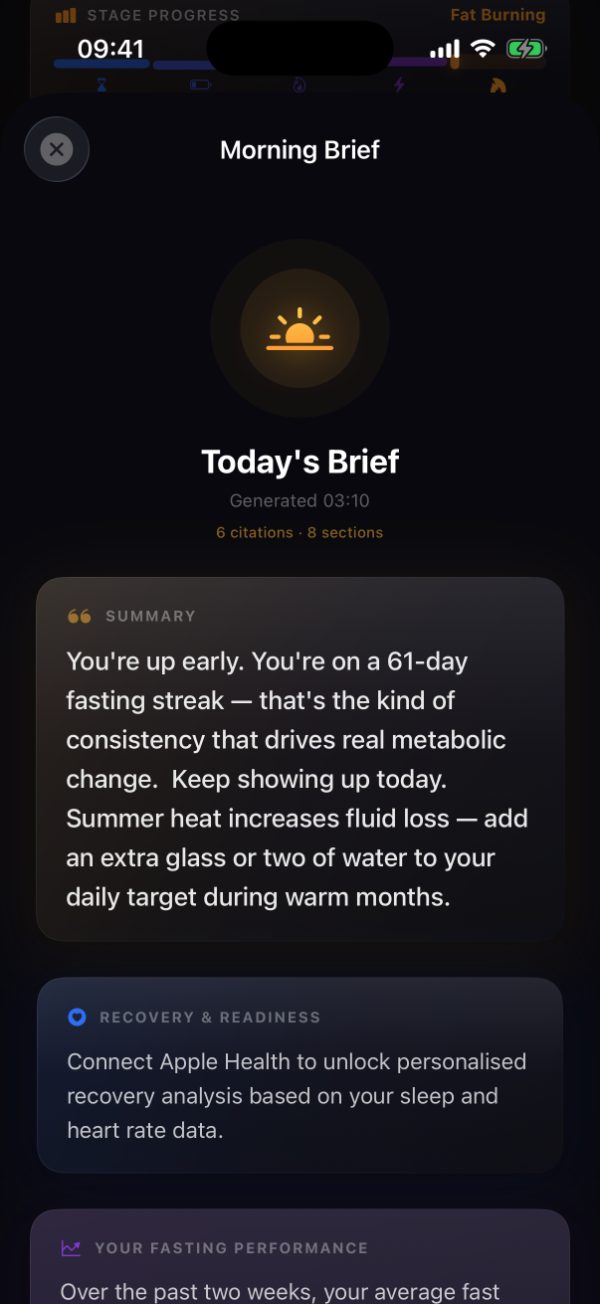
The electrolyte guide →A short night reads exactly like a hard fast. Before blaming the schedule, check whether you slept. Burn's Morning Brief puts both in front of you before you commit to a length.
Fasting and sleep →Ten hours to eat is not ten hours to under-eat. If your window is short and your intake dropped hard, the flat feeling is a food deficit, not fasting.
How to break a fast →If the first three check out and you are new to this, you are early in the switch from relying on glucose to using fat efficiently. The first two weeks are typically the flattest.
The fuel sequence →Adaptation or mismatch
Adaptation gets easier week by week. A schedule that does not suit you feels the same in week six as it did in week one, and that is the signal to change something.
ADAPTING
Week three is easier than week one. Hard hours arrive later and pass faster. You finish more fasts than you cut short.
MISMATCHED
Six weeks in and nothing has shifted. You are dreading the same hour, cutting fasts short, and eating past the deficit in the window.
A mismatch is not a failure of discipline. Drop back two hours, hold that for a fortnight, and move up when the length stops taking effort. A 14:10 you keep beats an 18:6 you abandon.
Getting through today
None of these break a fast.
A pinch of salt in a large glass. Try this before anything else, because it is the most likely fix and takes twenty minutes.
Black, both fine. Caffeine will not replace sleep, but it makes a flat afternoon workable.
A short walk lifts energy more reliably than sitting through it. Save the hard session for your eating window.
Ending at 14 hours instead of 18 is still a finished fast. Burn records the length you reached and the stage you got to.

In the app
Whether you are adapting or on the wrong schedule is a question about the trend, not today. Burn keeps completion rate and hours per week so the answer is on a chart rather than in your memory of feeling rough.
Cutting more fasts short than you did a month ago is the clearest sign the length is wrong.
Burn asks how hard it felt when you finish. Weeks of that reading, next to the hours, is what tells you whether it is getting easier.
WHEN TO STOP
Stop and eat if low energy comes with dizziness that does not settle, heart palpitations, shaking, or confusion. Those belong in a different category from a flat afternoon, and are worth raising with a doctor if they repeat.
Persistent fatigue over weeks deserves a conversation with your doctor rather than a longer fast, since plenty of things unrelated to fasting cause it.
Read the safety guidance →The shift in fuel use across a fast is well described, and the role of sodium and potassium in fatigue is established. How long adaptation takes varies widely between people and is an active research area. Claims here are drawn from peer-reviewed research and traced in our evidence policy.
Burn records what you log and names the stage the clock has reached. It does not measure your energy, your electrolyte status, ketosis, autophagy, or metabolic state.
Burn logs effort at the end of every fast and keeps your completion rate over time, so the trend answers the question.
Download free on the App StoreiPhone, iPad, and Apple Watch. Requires iOS 18 or watchOS 11.