HOME / GUIDES / FASTING FOR WEIGHT LOSS
Fasting works for weight loss mostly because a shorter eating window means less food. That is unglamorous, well supported, and the reason it keeps working when other approaches stop.
What the evidence supports, what the first two weeks actually look like, and the four things that decide whether it lasts.
The mechanism
Fasting is a way of eating less without counting every meal. There is a second effect on top of that, and it is smaller than the internet suggests.
These claims are drawn from peer-reviewed research and traced in our evidence packet.
THE MAIN EFFECT
Eight hours to eat in makes a large surplus harder to reach. No counting, no weighing, just fewer opportunities. In controlled trials, time-restricted eating produces weight loss comparable to other approaches at matched intake.
Which means the pattern you can keep matters more than the pattern that is theoretically best.
THE SECOND EFFECT
Extended periods without food mean more hours spent using fat for fuel. This is real physiology, and it is what Burn's stages describe.
How much it adds beyond the calorie effect is an active research area. Treat it as a bonus rather than the plan.
The first month
Knowing this in advance is what stops people quitting in week three, when the fast drop stops and the real rate begins.
WEEK 1
Glycogen is stored with water, and lower insulin makes the kidneys release sodium and fluid. Real on the scale, and not fat.
WEEK 2
The hard hour becomes predictable rather than a surprise, which is what makes the schedule feel manageable.
WEEK 3
The scale slows down. This is the point that reads as failure, and it is actually the beginning of the useful part.
WEEK 4
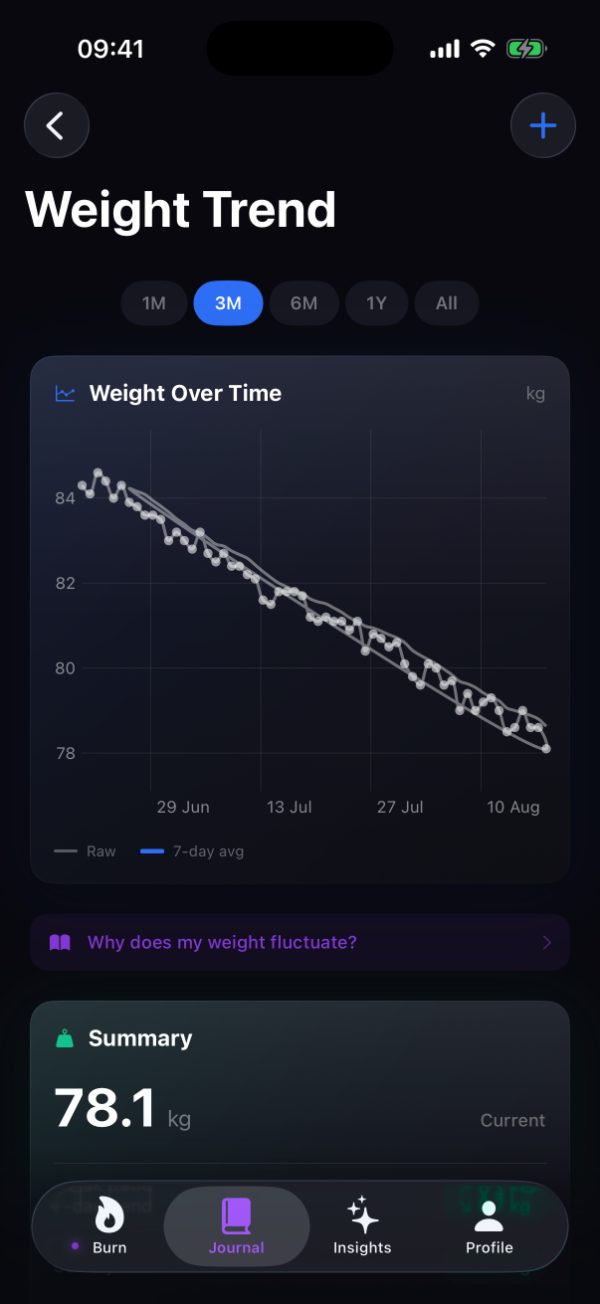
Four weeks of data beats any single morning's number. Burn charts the trend so one bad reading does not decide anything.

Reading the scale
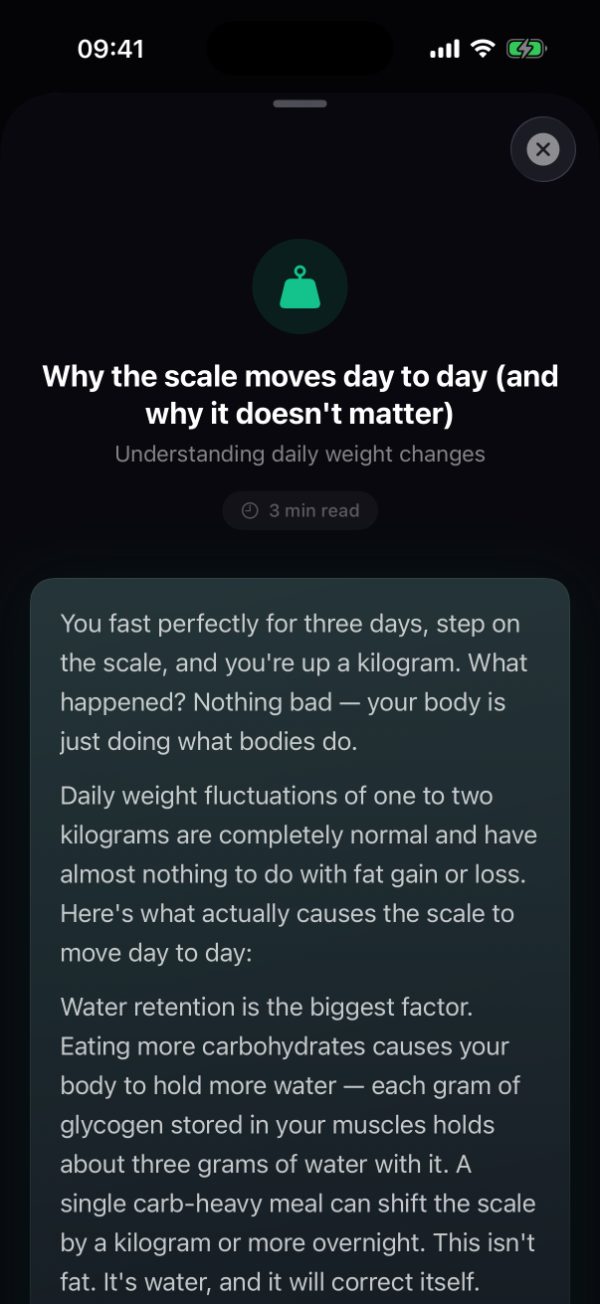
Water, salt, glycogen and the timing of your last meal all move the number overnight. Burn charts weight as a trend and keeps an article on exactly this question in the app.
Same time, same state, ideally each morning. Consistency in how you measure matters more than how often.
A two week view tells you whether the approach is working. A single day tells you almost nothing.
Hours per week and completion rate explain a flat month better than the scale does. Both sit in Insights.
What decides the outcome
People reach for a longer schedule when progress stalls. These are usually the better place to look.
01
Two normal meals, not a feast. Eating your way back through the deficit is what stops a fasting habit producing anything.
02
A shorter window does not make the contents irrelevant. Protein-led meals leave you fuller through the fast.
03
Both change appetite, and both make a schedule harder to keep. A bad sleep week usually shows up as a bad fasting week.
04
Five days a week for six months beats seven days a week for three weeks. Burn counts completions and streaks for exactly this reason.
Burn is a fasting timer. It does not diagnose or treat anything, it does not promise an outcome, and it does not measure ketosis, autophagy, or metabolic state. Body Score is a Burn product score, not a health or metabolic score.
Speak to a doctor before starting if you are pregnant or breastfeeding, have a history of eating disorders, manage diabetes, take medication timed to meals, or are under 18. If tracking weight daily is difficult for you, this is not the approach to force.
Burn charts weight alongside hours per week and completion rate, so you can tell a plateau from a bad Tuesday.
Download free on the App StoreiPhone, iPad, and Apple Watch. Requires iOS 18 or watchOS 11.