 Burn
Get Burn
Burn
Get Burn
HOME / SCIENCE / BLOOD KETONES
A finger-prick meter gives you a ketone figure from your own body in minutes. Where autophagy needs a laboratory, this needs a strip and thirty seconds.
Three methods are available, and each reads a different ketone in a different place.
BLOOD
A finger-prick meter reads beta-hydroxybutyrate, the main circulating ketone. The most reliable of the three.
BREATH
A breath device reads acetone. Reusable with no strips, and it tracks trends well.
URINE
Strips read excess ketones your body has passed rather than what is circulating. Cheapest, and least informative.
Three methods
This is why two methods can disagree while both are working correctly. Each is reading a different ketone in a different place.
BLOOD METER
Beta-hydroxybutyrate is the ketone your tissues actually use, so measuring it in blood tells you what is available as fuel at that moment.
Strips are a running cost, and it is a finger prick each time. This is the method research uses.
BREATH DEVICE
Acetone in your breath rises and falls with ketone production, so the direction of travel is reliable even though the absolute number is not directly comparable to a blood figure.
One purchase, unlimited readings, no blood. Good for checking the same hour across several fasts.
URINE STRIPS
Urine strips detect ketones being excreted, which is a different question from what is circulating. Hydration affects the result, and as your body becomes more efficient at using ketones it excretes fewer.
A strip can fade while your blood level is climbing. Useful as a rough first check.
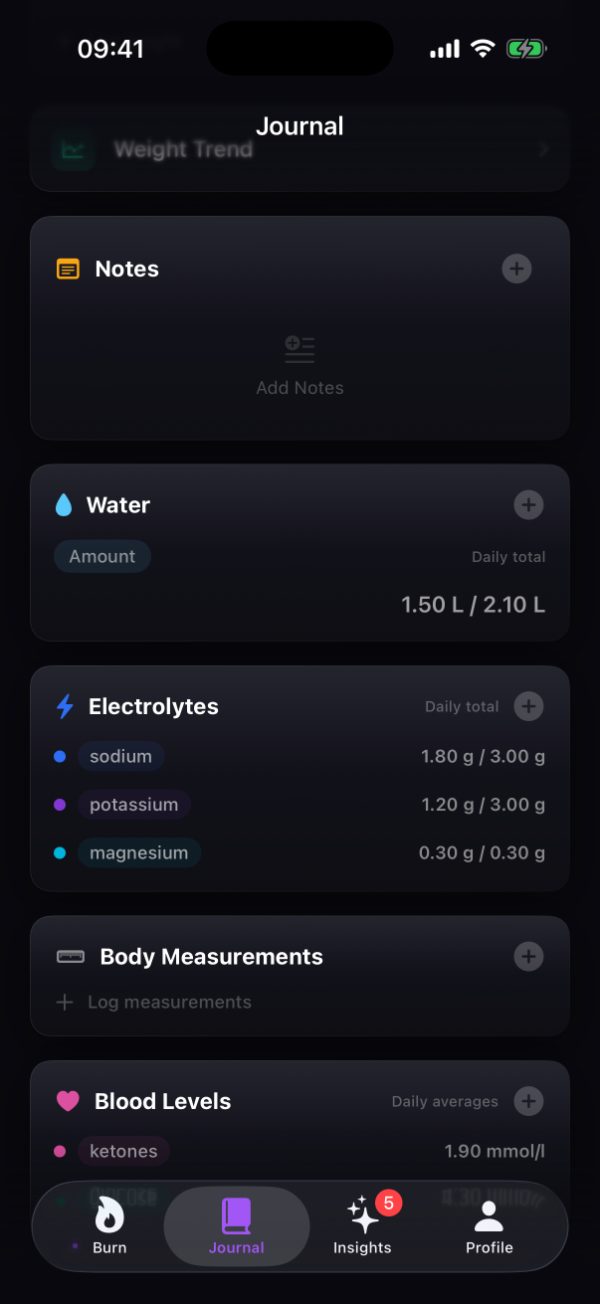
In the app
Blood Levels in the Journal holds ketone and glucose figures you have measured yourself. Burn keeps the numbers you record; it does not estimate them, and it does not measure ketosis, autophagy, or metabolic state.
The same figure means something different at hour 14 than at hour 40. Recorded alongside the fast, the elapsed time and the stage, it becomes part of a picture.
Measuring at hour 18 across several fasts tells you where your own onset sits. Single scattered readings tell you very little.
Reading a number well
Ketone levels vary widely between people on identical fasts, and a bigger figure is not a better fast.
YOUR OWN BASELINE
Your readings against your own history are useful. Your readings against someone else's are not, because diet, activity and metabolism all move the figure.
WHAT MOVES IT
Your last meal, your activity, your sleep and your metabolism. The same person on the same schedule can read differently on two consecutive days.
WHAT IT IS FOR
The best use of testing is finding where your own onset falls, so you know whether an 18 hour fast reaches for you what the timer names at 18 hours.
Beta-hydroxybutyrate as the primary circulating ketone, and the differences between blood, breath and urine measurement, are well described. Claims here are drawn from peer-reviewed research and traced in our evidence policy.
IF YOU MANAGE DIABETES
Elevated ketones alongside high blood glucose is a medical situation requiring urgent care, and it is not the same thing as nutritional ketosis during a fast. If you manage diabetes, your doctor should set the terms for both fasting and ketone testing.
Speak to a doctor before starting if you are pregnant or breastfeeding, have a history of eating disorders, manage diabetes, take medication timed to meals, or are under 18.
Read the safety guidance →Burn's Journal stores the ketone and glucose figures you measure, alongside the fast, the stage and the hour.
Download free on the App StoreiPhone, iPad, and Apple Watch. Requires iOS 18 or watchOS 11.