 Burn
Get Burn
Burn
Get Burn
Burn
Get Burn
Burn
Get Burn
HOME / SCIENCE / WHEN DOES KETOSIS START
Burn names Ketosis Entry at 18 hours. The biology does not have a start time in the way the question implies, because ketone production rises gradually rather than switching on.
Why a timer has to pick an hour, what shifts your own onset, and the one way to find out for certain.
THE SHORT ANSWER
18h
Where Burn's Ketosis Entry stage opens.
At 18 hours Burn moves you from Fat Mobilisation into Ketosis Entry, and describes it as ketone production becoming meaningful, with the brain beginning to supplement its glucose use with ketones.
That line is where a timer has to draw one. Your liver has been producing some ketones for hours before it, and will produce far more in the hours after. Nothing switches on at the boundary.
What happens at 18 hours →Why there is no single hour
The sequence runs continuously. Insulin falls, glycogen depletes, fatty acids are released, and the liver converts some of them into ketone bodies. Each step overlaps the next.
Any answer stated as a single hour, including Burn's, is a line drawn across a gradient. The gradient is the accurate picture.
What moves your own onset
A large carbohydrate-heavy dinner refills glycogen, which takes longer to work through than a smaller or lower-carbohydrate meal.
Exercise draws on glycogen, so a fast that includes a hard session reaches the same point sooner than one spent sitting down.
Sleep affects hormones that govern how you use fuel, which is part of why the same fast can feel different on different nights.
People who fast regularly often report reaching the same subjective point earlier, though how much of that is physiology and how much is familiarity is not settled.

Finding out for certain
Unlike autophagy, ketone levels have a test. If you want your own answer rather than a general one, this is how to get it.
A finger-prick test giving a direct reading. The most accurate option available outside a lab, and the one used in research.
Measures acetone on the breath as a proxy. Reusable and less invasive, though readings track blood levels loosely rather than exactly.
The cheapest option, and the least reliable for someone fasting regularly, since they measure what is being excreted rather than what is circulating.
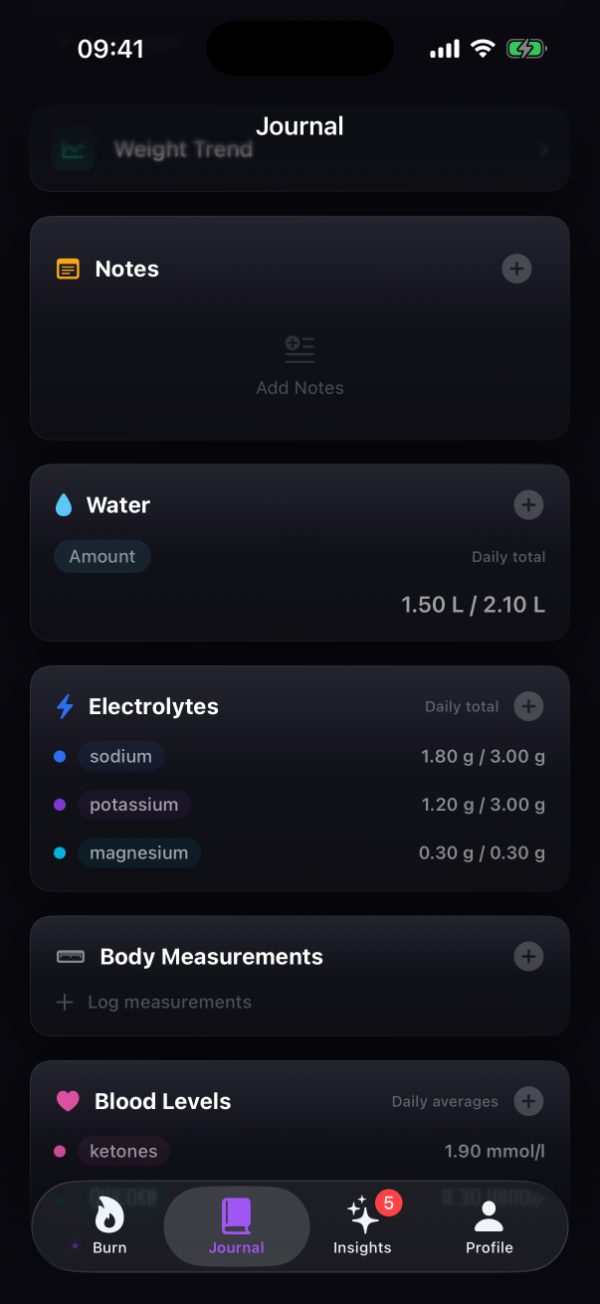
Burn does not measure ketosis. It maps elapsed time to named stages. If you do take readings, the Journal stores them under Blood Levels alongside your fasts, so you can see where your own onset actually falls against the timer.

Which schedules reach it
A 16:8 stops two hours short of it. An 18:6 lands on it, and going a little past your goal puts you inside the stage. A 20:4 spends two hours inside the stage, and anything longer passes through on the way to Fat Burning.
Finishes in Fat Mobilisation, short of the boundary.
Runs to the boundary itself.
Two hours inside Ketosis Entry before the window opens.
That the liver produces ketone bodies from fatty acids, and that circulating levels climb the longer you go without food, is well described in the literature. The hour at which any individual crosses a given threshold varies, which is why research reports ranges rather than a single figure. Claims are drawn from peer-reviewed research and traced in our evidence policy.
Burn is precise about the clock and honest about the biology. It names the stage the timer has reached, in language describing what is likely rather than what is measured. It does not measure ketosis, autophagy, or metabolic state.
Burn names all nine stages as you reach them, with a buzz on your wrist at every boundary.
Download free on the App StoreiPhone, iPad, and Apple Watch. Requires iOS 18 or watchOS 11.