 Burn
Get Burn
Burn
Get Burn
Burn
Get Burn
Burn
Get Burn
HOME / FASTING / 18:6 VS OMAD
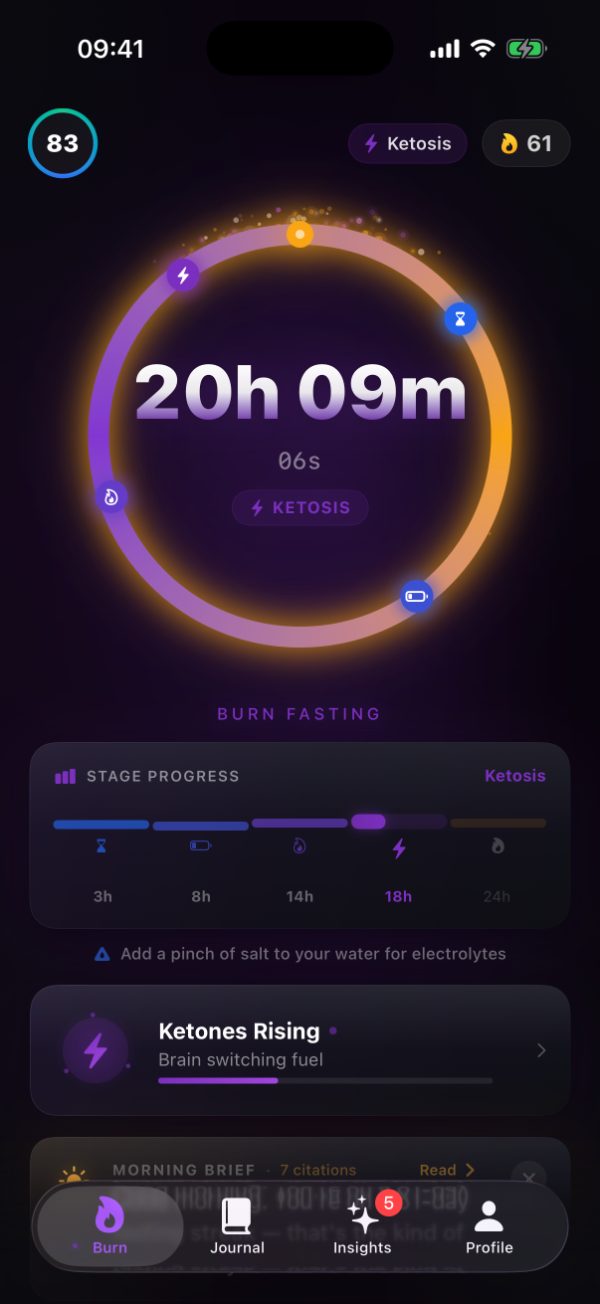
Both reach Ketosis Entry, 18:6 at its opening and OMAD five hours in. One gives you six hours to eat in, the other about one, and that is where the decision actually sits.
Here is what the extra five hours buy you, and what they cost.
18:6
ENDS AT THE KETOSIS ENTRY LINE
Two meals in six hours, usually a late lunch and a dinner. The fast ends exactly where Ketosis Entry opens, so running a little past your goal puts you inside the stage itself.
OMAD
ENDS INSIDE KETOSIS ENTRY
Roughly 23 hours fasting and a single sitting. Five hours further into the same stage, with the whole day's food in one meal and the window fixed to one hour of the evening.
Both reach Ketosis Entry, the stage where ketone production becomes meaningful and hunger often drops. Neither reaches Fat Burning, which does not open until 24 hours. The five hours between them are spent inside one stage, not crossing into a new one.
Where they differ
Since the stage is the same, everything that separates these two is about the eating side rather than the fasting side.
EATING
Six hours holds two proper meals and makes protein straightforward. A single sitting has to carry the whole day, and that takes planning rather than willpower.
FLEXIBILITY
Six hours absorbs a meal pushed back an hour or two. One hour does not, so OMAD asks for a week where your evenings are reliably yours.
TRAINING
Hard efforts want glycogen. Six hours gives you somewhere to put a session with food before and after it, which one hour cannot.
Choosing
It reaches the same stage as OMAD with a window that fits a normal evening. For most of what people want from a long daily fast, this is the version that survives a busy week.
Some people find a single meal easier to plan and easier to stop thinking about. If you like large meals and your evenings are predictable, the clock is not the difficult part.
Four hours is still one window but leaves room for a meal and something after it. It is the honest middle step, and switching plans keeps your history intact.

Time-restricted eating produces weight loss in controlled human trials, comparable to other approaches at matched intake. No trial establishes that a one hour window outperforms a six hour one. Which pattern a person can sustain matters more than which is theoretically optimal. Claims here are drawn from peer-reviewed research and traced in our evidence policy.
Speak to your doctor first if you are pregnant or breastfeeding, have a history of eating disorders, manage diabetes, take medication timed to meals, or are under 18. A one meal a day pattern makes it harder to meet your needs, so it deserves that conversation more than a six hour window does.
Both are built into Burn, and switching between them keeps every fast you have already logged.
Download free on the App StoreiPhone, iPad, and Apple Watch. Requires iOS 18 or watchOS 11.