 Burn
Get Burn
Burn
Get Burn
Burn
Get Burn
Burn
Get Burn
HOME / SCIENCE / FAT OXIDATION
Once fatty acids are circulating, your cells take them in and convert them to usable energy. This is the step that completes the process, and the one that matters for whether stored fat leaves for good.
Fasting raises the share of your energy that comes from fat, and Burn names the stages where that share shifts.
BEFORE
Lipolysis releases fatty acids from storage into your bloodstream.
THIS STEP
Cells take them up and oxidize them, releasing the energy they hold.
ALONGSIDE
The liver converts some fatty acids into ketones instead, for tissues that cannot use fat directly.
The proportion, not a switch
Your body runs on a mixture of fuels at all times. What changes across a fast is the share coming from fat rather than glucose.
AFTER EATING
With insulin elevated and glucose plentiful, your cells favor it. Fat oxidation continues at a low rate rather than stopping.
MID-FAST
As glycogen runs down and insulin stays low, more of your energy comes from fat. Burn names this Fat Mobilisation at 14 hours.
LONGER FASTS
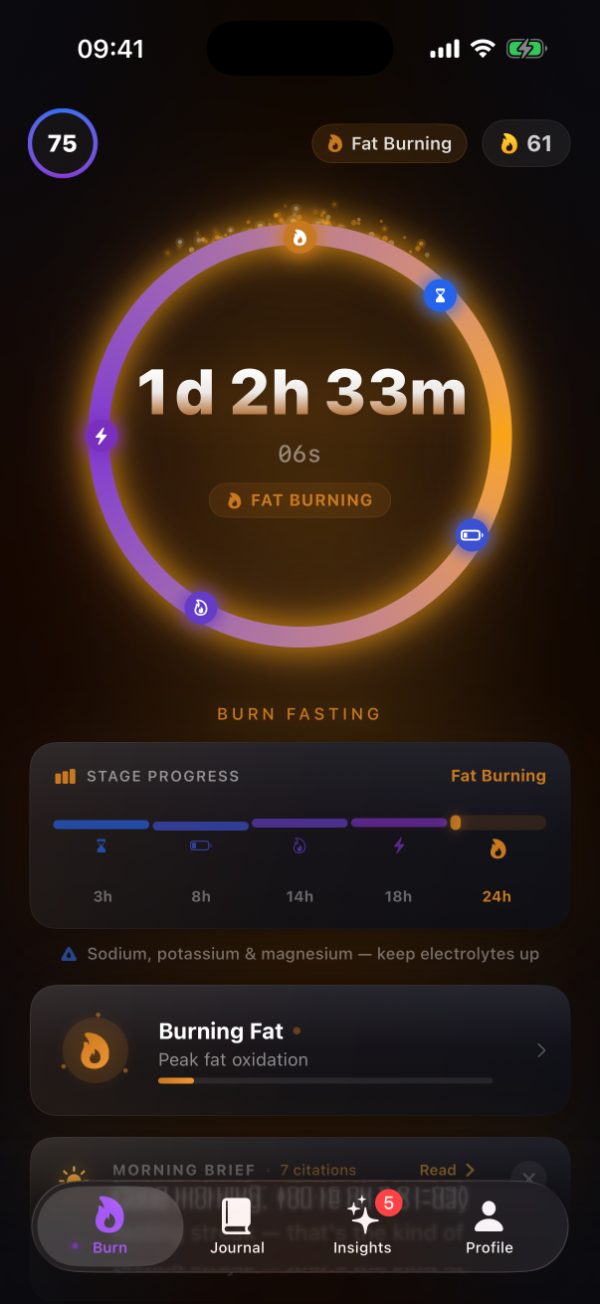
Past 24 hours, fat and the ketones made from it carry most of the load. Burn names the Fat Burning stage here and marks it as peak fat oxidation.

What raises the rate
Lipolysis controls supply. Oxidation follows demand. Which means the two levers are how long you go without food, and how much energy your body needs while you do.
Walking and easy cardio draw a larger share of their energy from fat than hard intervals do, which is why gentle movement pairs well with a fast.
Above a certain intensity, your body wants the faster fuel. That is a reason to put heavy sessions in your eating window, not a reason to avoid them.
A higher share of fat oxidation during the fasted hours does not offset a large surplus in the window. The two have to work together.
Measurement
Fat oxidation is assessed by respiratory exchange, which needs laboratory equipment and a measured breath sample.
IN A LAB
Burning fat and burning carbohydrate produce different ratios of carbon dioxide to oxygen consumed. Measuring that ratio in exhaled breath shows which fuel is dominating.
WHAT IT SHOWS
The result is the share of energy coming from each fuel while the measurement is running. It is a snapshot of the mix, not a total of fat lost.
WHAT BURN SHOWS
Burn maps elapsed time to named stages. It does not measure your fuel mix, ketosis, autophagy, or metabolic state, and no phone or watch can.
Fat oxidation, its measurement by respiratory exchange, and the shift in fuel mix across a fast are standard physiology. Claims here are drawn from peer-reviewed research and traced in our evidence policy.
Insulin falls, glycogen runs down, lipolysis releases fatty acids, and oxidation spends them. Each step depends on the one before it, which is why a fast produces a sequence rather than a single event.
Speak to a doctor before starting if you are pregnant or breastfeeding, have a history of eating disorders, manage diabetes, take medication timed to meals, or are under 18. Stop and eat if you feel unwell, whatever the timer says.
Burn names all nine stages as you reach them, with the reasoning written out in the app.
Download free on the App StoreiPhone, iPad, and Apple Watch. Requires iOS 18 or watchOS 11.