 Burn
Get Burn
Burn
Get Burn
Burn
Get Burn
Burn
Get Burn
HOME / SCIENCE / GLYCOGEN DEPLETION
Your liver keeps a limited store of glucose for exactly this situation. Running it down is the work of the first half of a fast, and nothing much else can happen until it is largely spent.
This is the stage that explains why a 12 hour fast and an 18 hour fast are not the same thing.
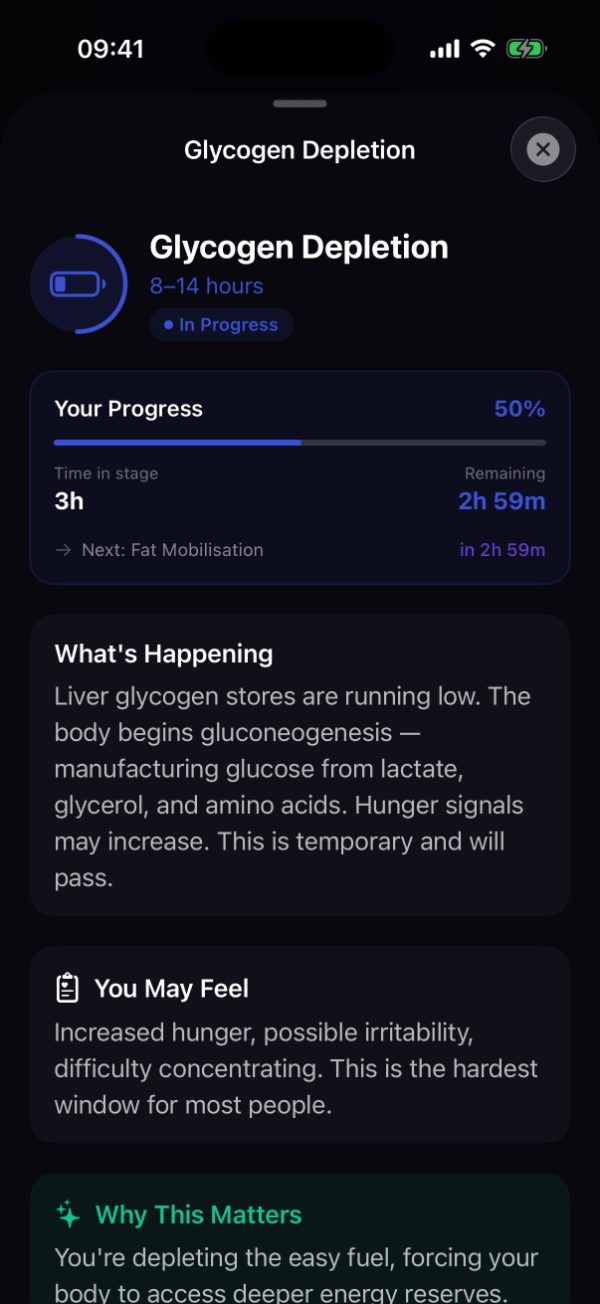
Six hours, and the longest stage before the boundary at 14. On the timer screen it shows as GLYCOGEN LOW.
What glycogen is
When you eat more carbohydrate than you need immediately, some is linked into long chains and stored. Your liver holds the portion that supplies your bloodstream; your muscles hold their own supply for their own use.
LIVER GLYCOGEN
Your liver can release glucose back into the blood to keep levels steady between meals. This is the store a fast draws down, and it is the smaller of the two.
MUSCLE GLYCOGEN
Muscle glycogen fuels the muscle that stores it and cannot be released into the bloodstream for general use. Fasting does not empty it; training does.
STORED WITH WATER
Glycogen is held alongside water. Drawing the store down releases that water too, which is a large part of the early drop on the scale.
How long it lasts
Liver glycogen supplies your blood glucose for a matter of hours rather than days. Beyond that, the number depends on things a timer cannot see.
A large carbohydrate meal tops the store up. A low-carbohydrate dinner leaves you starting the fast with less in reserve.
Exercise draws on glycogen. A hard session before or during a fast moves the depletion point earlier.
Body size, muscle mass and how much you move all change the rate you spend it. Two people on the same 16 hour fast are not at the same point at hour 12.
Burn names Glycogen Depletion from 8 to 14 hours because a timer has to draw a line. The line is the app's model, not a measurement of your store.
What you feel
Glucose is running low and fat has not yet taken over the load. That gap is where hunger and low energy tend to land, and it is why the hours before 14 are harder than the hours after.
It peaks and passes rather than climbing without end. Knowing that the wave breaks is most of what gets people through it.
Many people report feeling better once fat is carrying more of the load, which is past this stage rather than inside it.
The fluid released alongside glycogen takes sodium with it. A pinch of salt in your water addresses a real cause rather than a craving.


What comes next
Your brain still needs some glucose even on a long fast, and your body does not simply run out. Two processes cover the gap.
GLUCONEOGENESIS
Your liver can produce glucose from sources other than carbohydrate. This keeps blood glucose in range for the tissues that require it, and it is why a long fast does not send levels into freefall.
FAT MOBILISATION
With the easy fuel spent, fatty acids carry more of the load, and the liver begins converting some into ketones. This is the shift Burn names at 14 hours.
Glycogen storage in the liver and muscle, its release into the bloodstream, and its depletion across a fast are well described in the literature. Claims here are drawn from peer-reviewed research and traced in our evidence policy.
Burn maps elapsed time to named stages and does not measure your glycogen store, ketosis, autophagy, or metabolic state. Speak to a doctor before starting if you manage diabetes or take medication timed to meals.
Burn names all nine stages as you reach them, with a buzz on your wrist at every boundary.
Download free on the App StoreiPhone, iPad, and Apple Watch. Requires iOS 18 or watchOS 11.