 Burn
Get Burn
Burn
Get Burn
Burn
Get Burn
Burn
Get Burn
HOME / SCIENCE / INSULIN AND FASTING
Almost everything that happens during a fast traces back to one thing: with no food coming in, insulin falls. Fat release, ketone production, sodium loss and the early scale drop all follow from it.
Understand insulin and the rest of the fast stops feeling like a list of unrelated effects.
WHEN IT IS HIGH
Energy goes into storage. Glucose moves into cells, and fat stays where it is.
WHEN IT FALLS
Storage stops and release begins. Fatty acids leave fat cells and become available as fuel.
WHEN IT STAYS LOW
The liver converts fatty acids into ketones, and your brain gains a second fuel source.
What insulin does
Insulin is a hormone your pancreas releases when you eat, and its job is to move energy out of your bloodstream and into storage. High insulin means store. Low insulin means release.
AFTER A MEAL
Insulin rises, glucose moves from your blood into muscle and liver cells, and some is stored as glycogen. Fat release is suppressed while this is happening, because there is no reason to draw on reserves when fuel has just arrived.
This is normal and necessary. It is not something to be avoided, it is what eating does.
HOURS LATER
As the meal is absorbed, insulin comes down. With the brake off, fat cells release fatty acids into the bloodstream, and your body starts running more on fat and less on glucose.
A fast is simply an extended stretch in this second state.
What follows from it
These are usually explained separately. They are all downstream of the same drop.
Low insulin allows fatty acids out of storage. Without that drop, the fuel is there but locked.
Once fatty acids are flowing to the liver in quantity, it converts some into ketone bodies your brain can use.
Lower insulin tells your kidneys to release sodium and fluid. This is behind the extra bathroom trips and most fasting headaches.
Glycogen is stored with water, and the fluid loss above adds to it. Real on the scale, and not fat.
This is why salt matters more on a long fast than plain water does, and why the first week on a new schedule shows a scale drop that then slows down. Neither is mysterious once you know where it comes from.
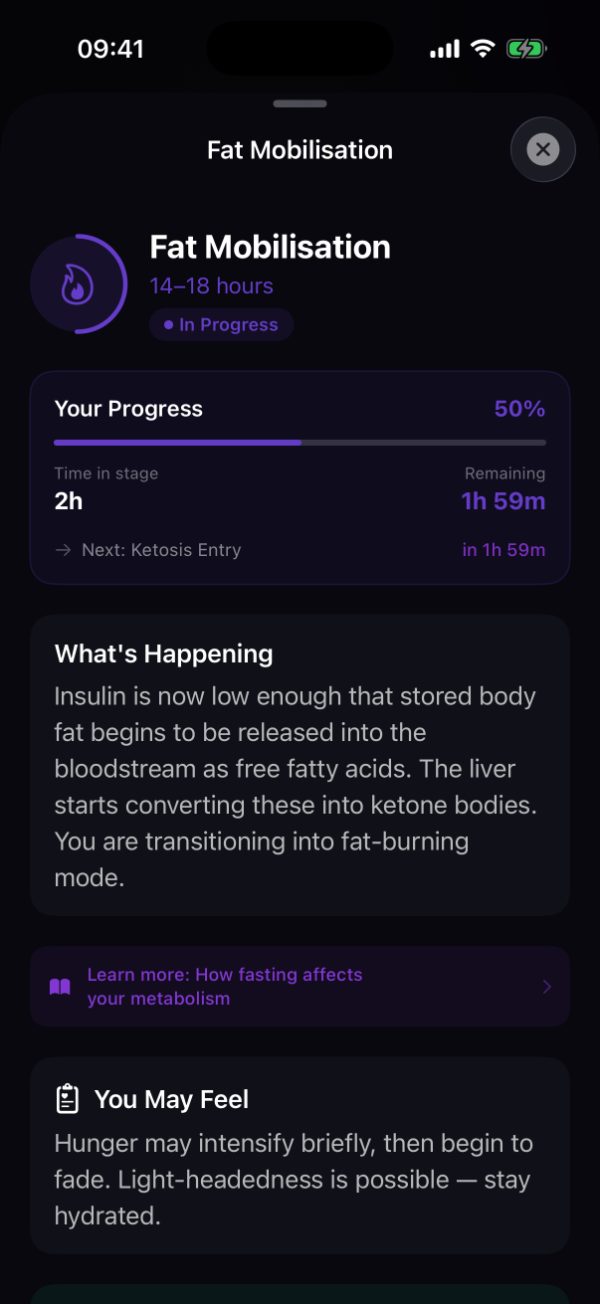
Where it sits in a fast
Insulin starts falling within a few hours of your last meal, well before anything feels different. What takes longer is the consequence: glycogen has to run down before fat carries a meaningful share of the load, and that is the stretch Burn calls Glycogen Depletion and then Fat Mobilisation.
Insulin falls hours before ketone production becomes significant. The first is a prerequisite for the second, not the same event.
This is the real answer to what breaks a fast. Food raises insulin, which switches storage back on and pauses the release you were waiting for.
Insulin does not keep falling indefinitely. Once it is low, extending the fast adds hours in that state rather than a deeper version of it.
Insulin sensitivity
Insulin sensitivity is how readily your cells respond to insulin, and improving it is one of the most cited reasons to fast. Here is what the evidence supports, separated by strength.
WELL ESTABLISHED
That insulin drops without incoming food, and that low insulin permits fat release, is standard physiology and not in dispute.
GOOD HUMAN EVIDENCE
Controlled trials report improvements in insulin sensitivity markers with time-restricted eating. How much comes from the timing itself rather than the accompanying weight loss is where the research is still working.
FOR YOUR DOCTOR
Insulin and glucose are measured with blood work ordered by a clinician. Burn stores readings you record yourself; it does not estimate them.
Claims here are drawn from peer-reviewed research and traced in our evidence policy. Burn maps elapsed time to named stages and does not measure ketosis, autophagy, or metabolic state.
Fasting changes blood glucose and insulin, so it interacts directly with medication and monitoring. Speak to your doctor before changing your eating pattern. The same applies if you take any medication timed to meals.
Speak to a doctor before starting if you are pregnant or breastfeeding, have a history of eating disorders, or are under 18. Burn is a fasting timer, not medical advice.
Burn names all nine stages as you reach them, with the reasoning written out in the app.
Download free on the App StoreiPhone, iPad, and Apple Watch. Requires iOS 18 or watchOS 11.