 Burn
Get Burn
Burn
Get Burn
Burn
Get Burn
Burn
Get Burn
HOME / FASTING / 24-HOUR VS OMAD
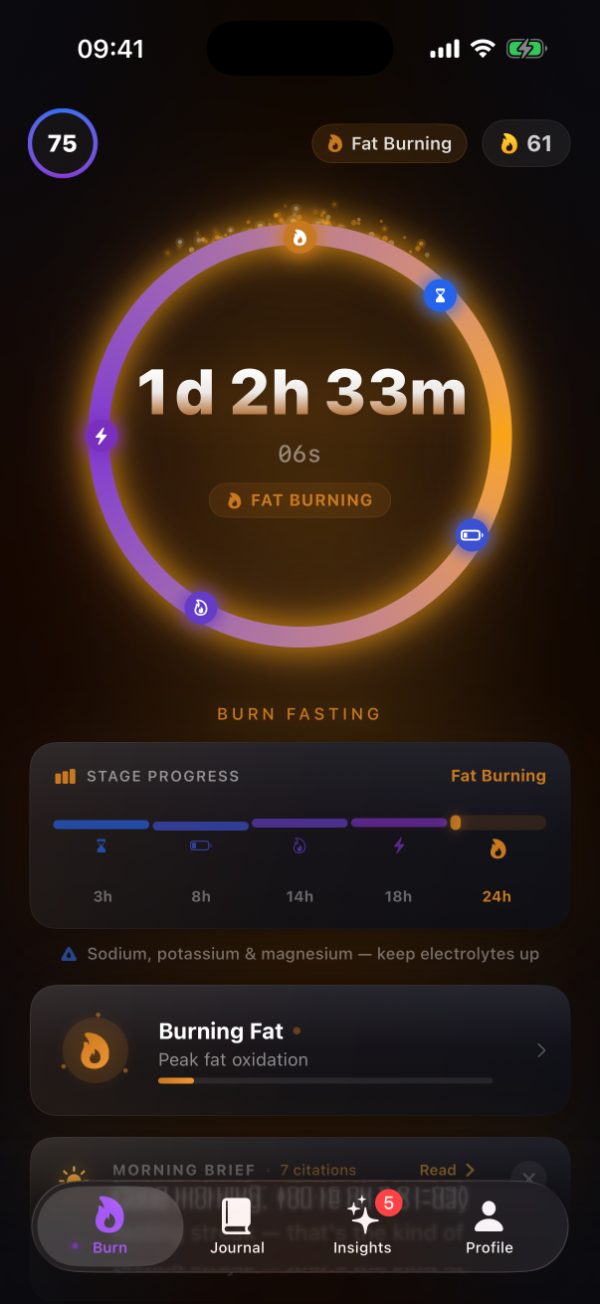
About an hour of clock separates them, and it is the hour that opens Fat Burning. The larger difference is that one is a weekly event and the other is every single day.
Same length of fast, entirely different demand on your week.
24h
REACHES THE FAT BURNING LINE
Dinner to dinner, so you skip breakfast and lunch on one day and never spend a whole calendar day without eating. This page takes the once or twice a week version; 4:3 and Alternate Day run the same fast three or four times a week.
OMAD
STOPS INSIDE KETOSIS ENTRY
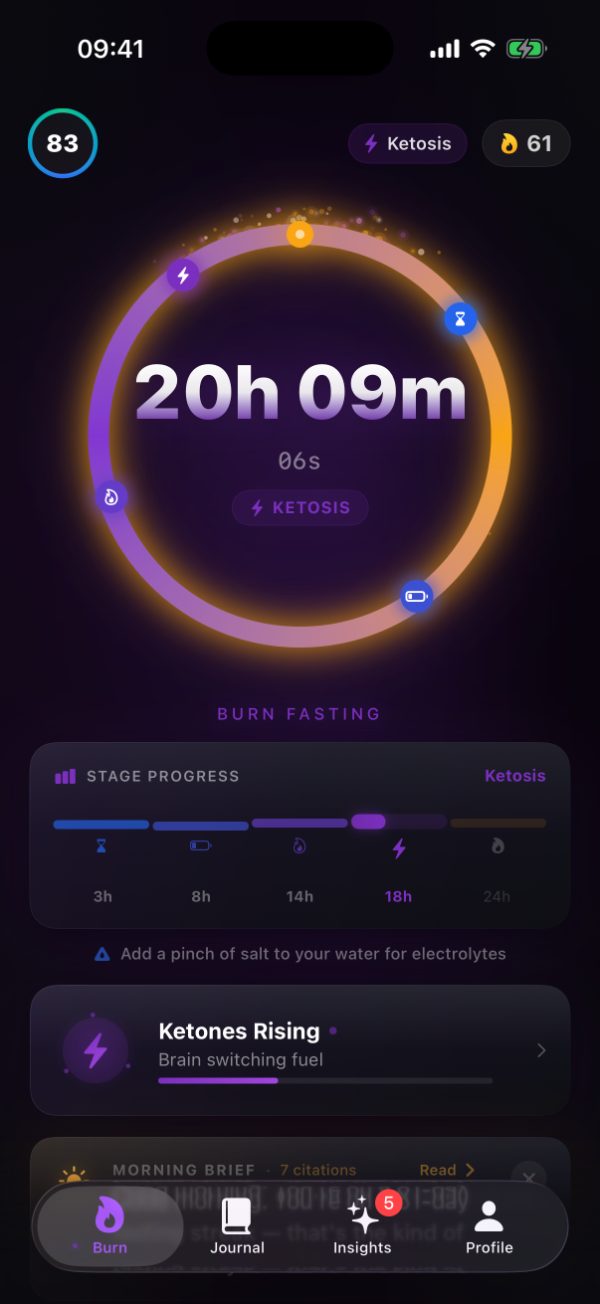
One meal a day, repeated. Each fast stops about an hour short of Fat Burning, but there is no ordinary day to fall back on, because every day is the fasting day.
The clock difference is about an hour, and it lands on a boundary. A 24-hour fast reaches the Fat Burning line as it ends rather than spending time in the stage, which is why that band is shown faded; OMAD finishes inside Ketosis Entry. Whether that hour matters to you is a smaller question than whether you want to do this daily or weekly.
The real question
A fast of this length is demanding either way. What separates these two is how much of your week it occupies.
RECOVERY
Run once or twice a week, a 24-hour fast leaves five or six ordinary days to eat normally and train properly. OMAD has one hour a day, every day, with nothing to fall back on.
MEETING YOUR NEEDS
Getting a full day of food and enough protein into a single sitting takes planning, and doing it every day compounds any shortfall. A weekly fast has ordinary days either side to absorb it.
SOCIALLY
A once or twice weekly fast can be shifted to whichever day is quiet. OMAD asks the same hour of every evening to be yours, which is harder on an unpredictable week.
Choosing
It reaches Fat Burning, which OMAD does not, and it leaves the rest of the week alone. Eat-Stop-Eat is this pattern as a program: two 24-hour fasts a week, five ordinary days.
Some people find one decision every day easier than one hard day a week. If your evenings are reliably yours and you like large meals, the repetition is the point rather than the problem.
After 24 hours you do not need a careful refeed, but a very large meal will sit badly. Something ordinary, eaten slowly, is enough on both patterns.
Intermittent fasting patterns produce weight loss in controlled human trials, comparable to other approaches at matched intake. No trial establishes that a daily near-24-hour fast outperforms a weekly one. Which pattern a person can sustain matters more than which is theoretically optimal. Claims here are drawn from peer-reviewed research and traced in our evidence policy.
Speak to your doctor first if you are pregnant or breastfeeding, have a history of eating disorders, manage diabetes, take medication timed to meals, or are under 18. A daily one meal pattern makes it harder to meet your needs, so it deserves that conversation more than an occasional 24-hour fast does. Stop and eat if you feel unwell, whatever the timer says.
Burn times every fast to the second and names each stage as you reach it, with a buzz on your wrist at every boundary.
Download free on the App StoreiPhone, iPad, and Apple Watch. Requires iOS 18 or watchOS 11.