HOME / FASTING / 72 HOUR FAST
Three days without food. It spends the final 24 hours in Deep Ketosis and finishes where the Autophagy stage begins.
A fast this long should be planned with a doctor, including how you come off it. That is where this page starts.
72h
Total fast
7
Stages passed
BEFORE ANYTHING ELSE
Fasts of three days or more should be planned with a doctor, and that includes how you break them. Refeeding after a fast this long is the part that carries real clinical risk, and it is worth having a plan agreed before you begin.
Do not attempt a fast of this length if you are pregnant or breastfeeding, have a history of eating disorders, or are under 18. Speak to your doctor first if you manage diabetes or take medication timed to meals. Stop and eat if you feel unwell, whatever the timer says.
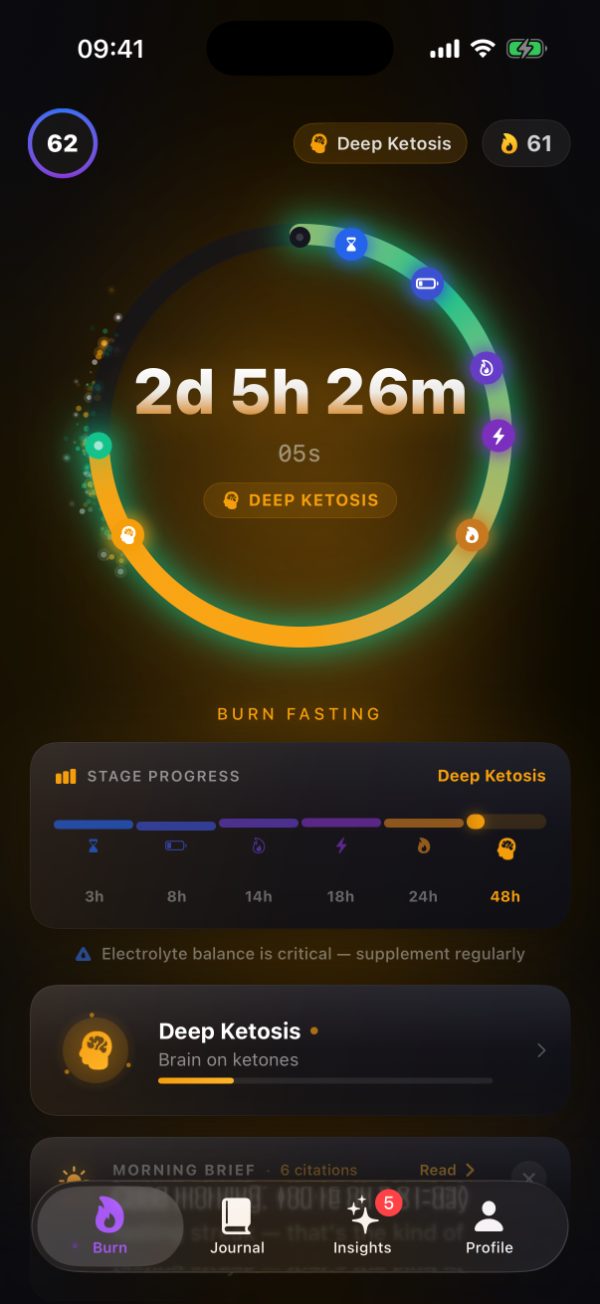
Three days covers seven of the nine stages. The last two both run a full 24 hours, so the second and third days are each spent almost entirely in a single stage.
The final day
What's happening
The brain is running predominantly on ketones. Appetite suppression is significant. Insulin is at its lowest. Metabolic adaptation is in full effect. This is the sweet spot for extended fasters.
You may feel
Very little hunger. High mental clarity. Possible metallic taste. Strong sense of calm.
The metallic taste is a common effect of elevated ketones. Very little hunger is the part that surprises people who have not fasted this long.

The three days
Hunger is the first day's problem. Hydration and electrolytes are the second and third day's.
DAY ONE
You pass every stage a daily fast reaches. The waves cluster around your usual meal times and pass on their own. Keep the day occupied and the evening quiet.
DAY TWO
Appetite falls away and thinking often sharpens. This is where electrolytes stop being optional, because you have gone two days without sodium arriving with food.
DAY THREE
Insulin is at its lowest, and Burn names a strong sense of calm at this stage. Plan the exit rather than improvising it, and keep any physical demands light.
Burn shows a stronger electrolyte reminder as a fast passes into Deep Ketosis, and keeps sodium, potassium and magnesium in the Journal alongside your water.
Electrolytes →

Why people choose 72
That is the usual reason for choosing three days over two. It is worth knowing what the boundary is and is not.
It runs in your cells all the time and increases as a fast lengthens. It does not switch on at 72 hours, and Burn draws the line there because a timer has to draw one.
Autophagy is assessed in tissue, in a laboratory. Burn names the stage the clock has reached and does not measure autophagy, ketosis, or metabolic state.
Much of the research comes from animal models, and translating those findings into human hours is an active research area.
A 72 hour fast is not a stronger version of a 16:8, and doing one does not compound. What you eat across the week, how you sleep, and whether the pattern is repeatable still decide most of the outcome. Extended fasting raises the importance of hydration and of how you break the fast. Build up through 24 and 48 hours before attempting three days.
Onset of each physiological shift varies with your last meal, your activity, your sleep and your metabolism. Burn maps elapsed time to named stages and states how firm the evidence is at each one. Claims here are drawn from peer-reviewed research and traced in our evidence policy.
Burn names every stage as you reach it, keeps your water and electrolytes beside the clock, and holds the record afterwards.
Download free on the App StoreiPhone, iPad, and Apple Watch. Requires iOS 18 or watchOS 11.