 Burn
Get Burn
Burn
Get Burn
HOME / SCIENCE / BLOOD GLUCOSE AND FASTING
Your body holds blood glucose within a narrow band whether you have eaten or not. A fast changes where that glucose comes from, not whether it is there.
Glucose regulation is the reason a long fast is possible, and the reason some people need medical supervision to attempt one.
Three different sources, one steady level. Supply switches; the target does not.
Reading your own numbers
Continuous monitors have made mid-fast glucose visible to a lot of people who are not diabetic. These three patterns account for most of the confusion.
Seeing a normal reading at hour 18 does not mean the fast is achieving nothing. Regulation is holding the level while the fuel supply shifts underneath it.
Glucose commonly rises in the early morning as hormones prepare you to wake, even while you are still fasting. It is a described physiological pattern rather than something you did wrong.
Hard efforts prompt the liver to release glucose to meet demand, so a reading can climb during a fasted workout. That is supply meeting demand.
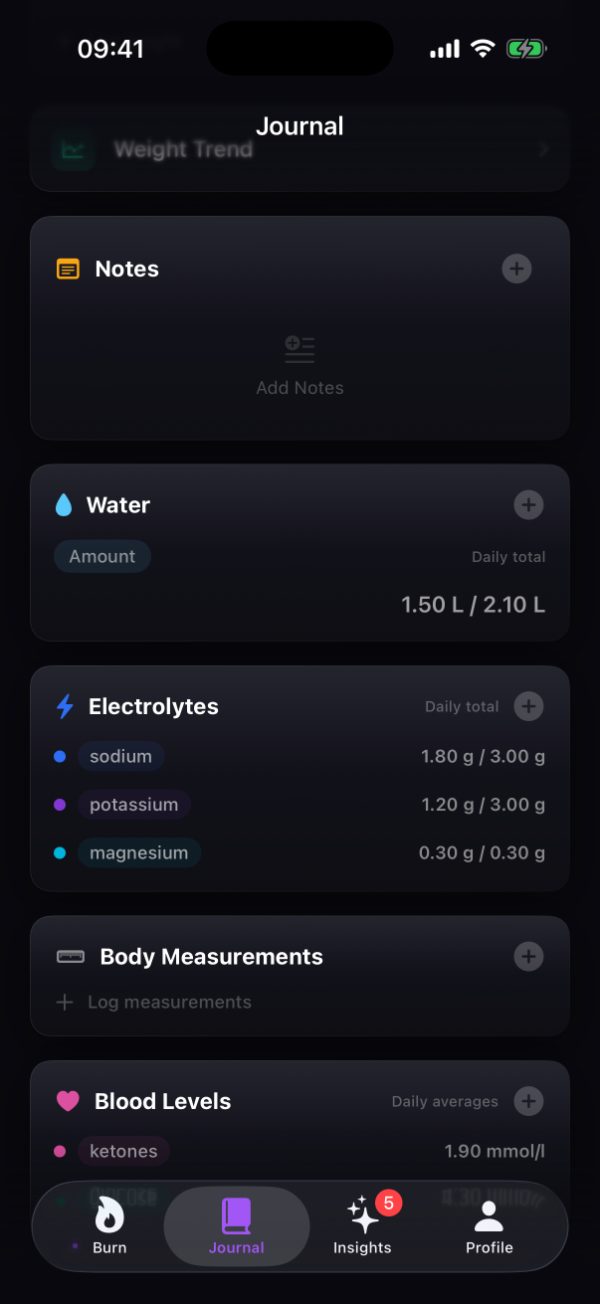
Burn's Journal stores glucose readings you have taken yourself, alongside ketones, so a number sits with the fast, the hour and the stage that produced it.
Ketones and glucose together
Glucose settling while ketones climb is the fuel switch visible in two numbers. Recorded together at the same hour across several fasts, they show you where your own transition falls.
A number at hour 18 on four different fasts is informative. Four numbers at four random hours are not.
Blood Levels stores your own figures. Burn maps elapsed time to named stages and does not measure ketosis, autophagy, or metabolic state.
Medical supervision
Fasting alters blood glucose directly, which puts it inside how diabetes medication is dosed and timed. That makes it a clinical decision rather than a lifestyle one.
MEDICATION TIMING
Insulin and several oral medications are timed to meals. Removing the meal without adjusting the dose is where the risk sits, and only your prescriber can make that change.
WARNING SIGNS
These are different from ordinary hunger. Stop and eat, then speak to a doctor. This holds whether or not you have a diagnosis.
WHAT BURN IS
Burn times the fast and names the stage the clock has reached. It does not diagnose or treat anything, and nothing here replaces advice from your own doctor.
Glucose regulation across the fed and fasted states, and the early morning rise, are standard physiology. Claims here are drawn from peer-reviewed research and traced in our evidence policy.
Reference ranges depend on the measurement, the timing and your own clinical picture, and they are set by your doctor rather than by a fasting app. Burn describes what happens across a fast and leaves the figures to the people who can interpret them for you.
Speak to a doctor before starting if you are pregnant or breastfeeding, have a history of eating disorders, manage diabetes, take medication timed to meals, or are under 18.
Burn's Journal stores the glucose and ketone figures you measure, alongside the fast, the stage and the hour.
Download free on the App StoreiPhone, iPad, and Apple Watch. Requires iOS 18 or watchOS 11.