HOME / FASTING / WARRIOR DIET
Twenty hours of fasting, then one large evening meal. The pattern is a daily 20:4, with all the eating pushed to the end of the day.
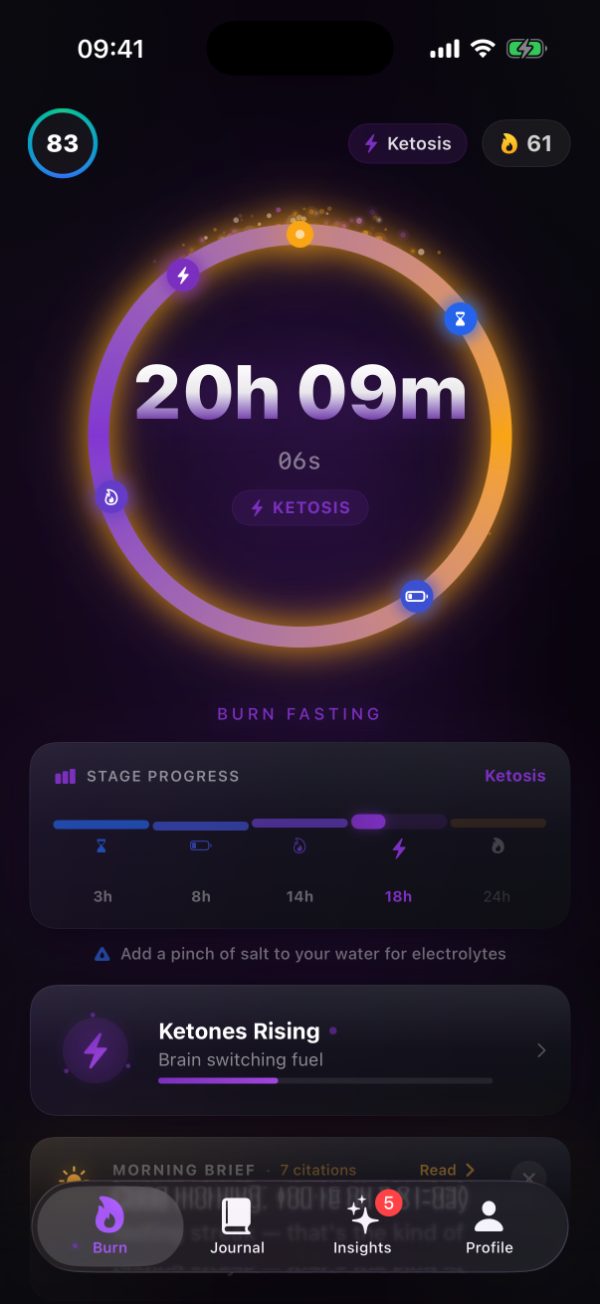
Burn runs it as a 20:4 schedule and times it to the second. What follows is what the protocol asks of you, and where its original claims outrun the evidence.
The protocol
The original protocol describes an undereating phase and an overeating phase. In practice most of what makes it work is the timing, not the phase names.
20 HOURS
Water, black coffee, plain tea, salt and electrolytes without calories. The original protocol allows small amounts of raw fruit and vegetables during this window, which does break the fast in the strict sense.
Burn times whichever version you run. If you want the clock to mean a complete fast, keep the window to zero calories.
4 HOURS
One large evening meal, or a meal and something after it. Four hours is enough to eat a full day's food without rushing, which is the point of putting it at the end of the day.
Overeating is the protocol's own word for this phase. A full day's intake is what it means, not a surplus on top of one.
Strip the phase names away and the Warrior Diet is a 20:4 with the window in the evening. That is how Burn runs it, and how the timer counts it.
Where a 20 hour fast lands
This is what separates the Warrior Diet from a 16:8. Twenty hours puts you past the Ketosis Entry boundary rather than approaching it.
The first day runs at one scale and Fat Burning is compressed against it at three to one, so the early hours stay readable. A 20 hour fast ends two hours into Ketosis Entry, which shows as KETOSIS on the timer screen.
Reading the claims
The Warrior Diet arrived with claims about ancestral eating patterns and specific food-combining rules. The fasting window has good human evidence behind it. The rest does not.
Eating within a short daily window produces weight loss in controlled trials, comparable to other approaches at matched intake. A 20:4 is one version of that.
How ancient soldiers or hunter-gatherers ate is a narrative, not a trial. It tells you nothing about what a 20 hour window does in your body.
The specific ordering rules attached to the eating window are not supported by evidence. Total intake and consistency are what the research points at.

Running it well
By hour twenty the hunger has often settled. What has not settled is lunch with colleagues, or breakfast with your family.
PROTEIN
Four hours to eat a full day's intake means the meal has to be substantial and deliberate. Plan it rather than assembling it at nine at night.
ELECTROLYTES
A lot of what people read as a fasting headache is fluid and sodium. Burn logs water and electrolytes together.
TRAINING
Heavy lifting and hard intervals want glycogen. Late afternoon, close to the window opening, is the practical slot on a 20:4.
Warrior Diet or OMAD
Both push all the eating to one part of the day. The window length is the whole difference.
Warrior Diet
The fast ends two hours into Ketosis Entry, then a four hour window opens. Room for a meal and something after it, which makes a day's intake achievable without discomfort.
Choose it if you want the depth of a long daily fast with a window you can actually eat properly in.
OMAD
One hour, one meal. Deeper into Ketosis Entry, and a harder place to fit a full day's food. The simplest rule to follow and the hardest to execute.
Choose it if a single meal suits you better than watching a window.
BEFORE YOU START
Do not use this schedule if you are pregnant or breastfeeding, have a history of eating disorders, or are under 18. Speak to your doctor first if you manage diabetes or take medication timed to meals, since a single daily eating window changes when those doses land. Stop and eat if you feel unwell, whatever the timer says.
WHAT BURN DOES
Burn maps elapsed time to named stages and does not measure ketosis, autophagy, or metabolic state. Nothing in the biology switches on at a stated hour; onset varies with your last meal, your activity, your sleep and your metabolism. Claims here are drawn from peer-reviewed research and traced in our evidence policy.
Burn runs the 20:4 schedule, names every stage you reach, and keeps the history so you can see which weeks held.
Download free on the App StoreiPhone, iPad, and Apple Watch. Requires iOS 18 or watchOS 11.