HOME / FASTING STAGES / 20 HOURS
Twenty hours is two hours into Ketosis Entry. Ketone production is meaningful, your brain is supplementing glucose with ketones, and hunger has usually eased rather than intensified.
It is where a 20:4 finishes, and the longest hour a daily schedule reaches before extended fasting begins.
Four hours still separate you from Fat Burning.
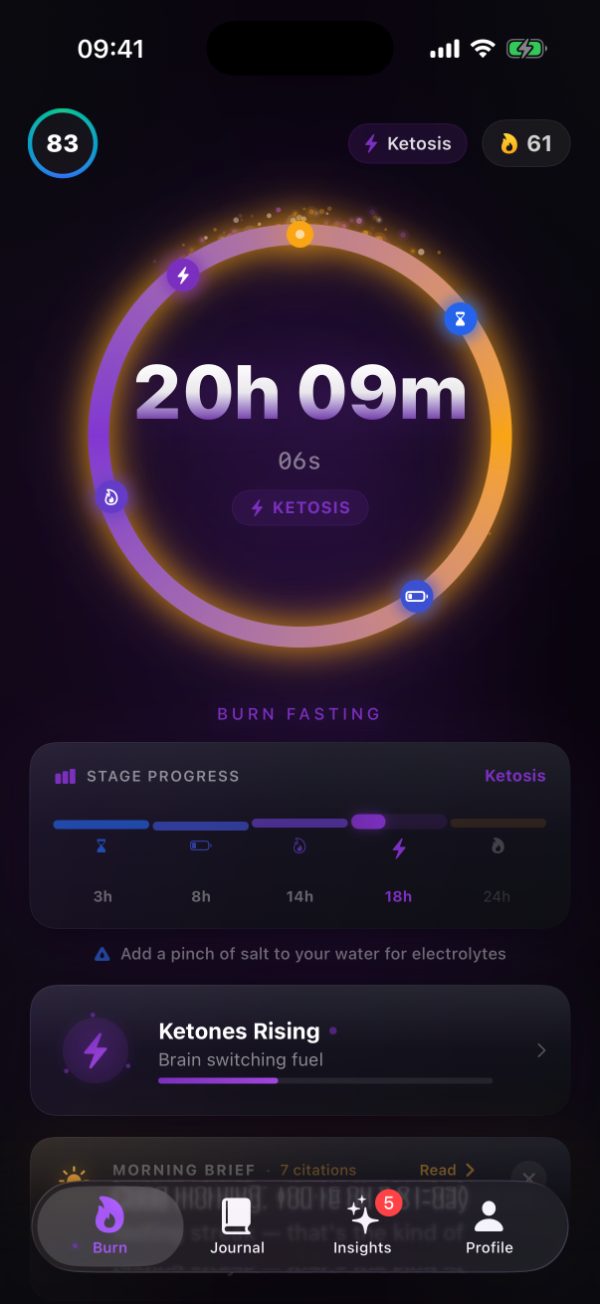
On the timer screen, where space is tight, Ketosis Entry shows as KETOSIS.
The stage itself
What's happening
Ketone production is meaningful. The brain begins supplementing its glucose use with ketones. Many people experience a mental clarity shift at this stage. Hunger often subsides.
You may feel
A shift in mental clarity. Hunger often drops noticeably. Some experience a mild euphoria.
By hour 20 you are past the hardest window rather than approaching it. The wave that catches people lands around 14 hours, six hours behind you.

Ketone levels climb the longer a fast runs. At 20 hours you have spent two hours inside the stage where that production becomes meaningful.
Hunger often subsides in this stage. Reaching 20 hours is often easier than reaching 15, which is the part that surprises people on a first attempt.
Twenty hours without food means twenty hours without sodium from meals. A pinch of salt in your water prevents most of what gets blamed on the fast.
Reaching this hour
A 20:4 finishes here. OMAD runs roughly to 23 hours. Anything longer crosses into Fat Burning and becomes a different kind of fast.
20:4
Finishes exactly here, with a four-hour window. Harder socially than physically, since one window that narrow rules out most shared meals.
The 20:4 guide →OMAD
One meal a day, so roughly 23 hours fasted. Passes this hour with three to go, still inside Ketosis Entry when it ends.
The OMAD guide →24h+
Four more hours reaches Fat Burning, the stage where growth hormone rises and the fast stops being a daily habit.
What happens at 24 hours →Finishing well
Two proper meals inside four hours, not one enormous one. Eating your way back through the deficit is the most common reason a long daily fast achieves nothing.
A short window makes it easy to fall short on protein across the day. Start the meal with it rather than treating it as what fills the remaining space.
Hard efforts want glycogen, and at 20 hours there is little left. Put demanding sessions close to the start of your window.

WELL ESTABLISHED
That the liver produces ketone bodies from fatty acids, and that levels climb the longer you go without food, is well described. A blood or breath test gives you your own number. Claims here are drawn from peer-reviewed research and traced in our evidence policy.
VARIES BY PERSON
Onset shifts with your last meal, your activity, your sleep and your metabolism. Burn draws the Ketosis Entry line at 18 hours because a timer has to draw one. It maps elapsed time to named stages and does not measure ketosis, autophagy, or metabolic state.
Burn names all nine stages as you reach them, with a buzz on your wrist at every boundary.
Download free on the App StoreiPhone, iPad, and Apple Watch. Requires iOS 18 or watchOS 11.