 Burn
Get Burn
Burn
Get Burn
Burn
Get Burn
Burn
Get Burn
HOME / SCIENCE / FED VERSUS FASTED
Your body is either putting energy away or taking it out. It does both every day, and a fast is simply a longer stretch of the second one.
Neither state is good or bad. You need both, and a normal day contains both. What fasting changes is how much time you spend in each.
The crossing
The shift is gradual. Absorbing a meal takes hours, and the two states overlap while it happens, which is why "fasted" is better understood as a direction of travel than a switch.
FIRST FEW HOURS
Your meal is still being digested and taken up. Insulin is elevated, and nothing about the fast has started in any meaningful sense. Burn calls this the Fed State.
THE MIDDLE
Insulin has come down and the liver is supplying glucose from its store. You are in the fasted state, and this is also the state you wake up in every morning.
LATER
Once the glycogen store is largely spent, fat has to carry more of the load. This is the part an overnight gap between dinner and breakfast does not reach.
Why the distinction matters
You are in the fasted state every morning before you eat. Nobody calls that intermittent fasting, and the reason is that a short overnight gap does not go far enough to change much.
Twelve hours from dinner to breakfast puts you in the fasted state, with the glycogen store still doing the work. That is a normal night, not a training effect.
Push past that and the store runs low, so fat takes a larger share. This is what a 16:8 or 18:6 is built to reach.
Food raises insulin, which switches storage back on. That is the actual reason milk in your coffee matters and a pinch of salt does not.

Two words worth separating
The fasted state is a routine, regulated condition your body handles every night. Starvation is a clinical state that follows prolonged deprivation. They are not points on the same scale.
REGULATED
Your liver releases stored glucose and can produce more from other material, which is why levels do not collapse during a normal fast.
FUEL AVAILABLE
The fasted state exists because your body is built to draw on stored energy between meals. That is the mechanism working, not failing.
WHERE THE LINE IS
Fasts of three days or more, including how you break them, should be planned with a clinician. Stop and eat if you feel unwell, whatever the timer says.
The fed and fasted states, and the hormonal control behind them, are standard physiology. Claims here are drawn from peer-reviewed research and traced in our evidence policy.
In the app
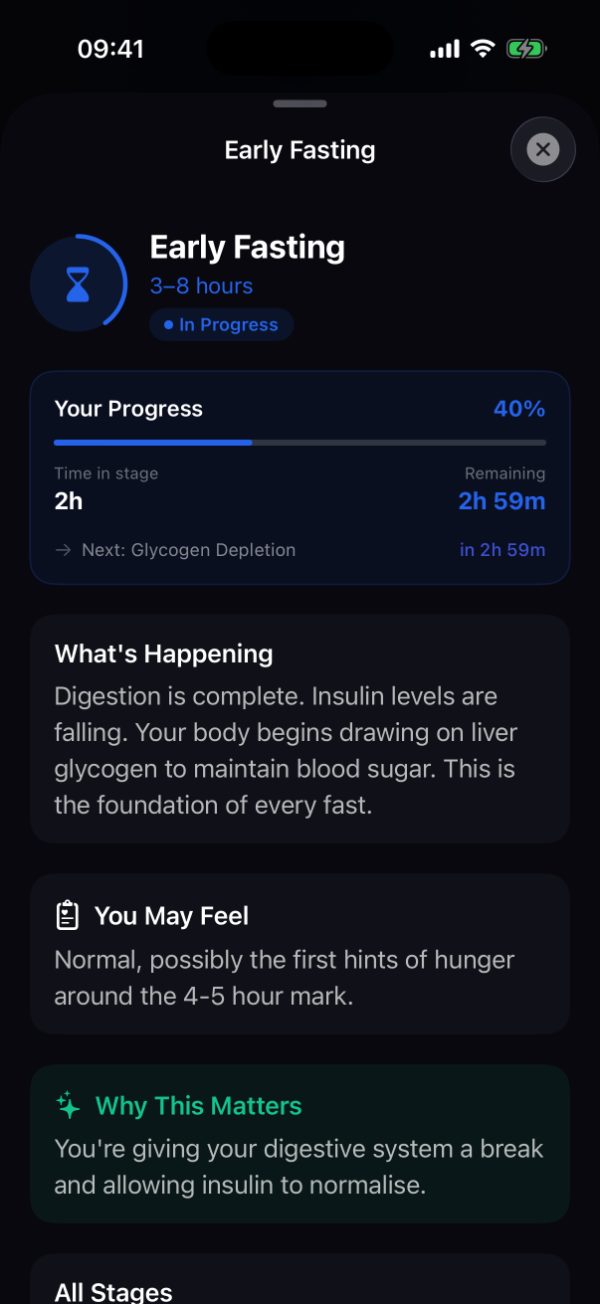
Fed State covers the first three hours, while your meal is still being absorbed. Early Fasting runs from three to eight, once insulin has come down and the liver is supplying glucose.
Both are named on the timer as you reach them. Burn maps elapsed time to named stages and does not measure ketosis, autophagy, or metabolic state.

Burn names all nine stages as you reach them, with a buzz on your wrist at every boundary.
Download free on the App StoreiPhone, iPad, and Apple Watch. Requires iOS 18 or watchOS 11.